


–
June 30, 2026
their investments and discover that their shares are no longer in their demat account. In many cases, these shares have not been stolen or lost they have been transferred to the Investor Education and Protection Fund, commonly known as IEPF.
If you have been investing for years, or if you have inherited investments from a family member, it is worth taking a few minutes to check whether your shares have been transferred to IEPF. The process is simpler than most people think, and the amount of money involved can be significant.
This guide will walk you through exactly how to check if your shares are transferred to IEPF, what to do if they have been, and how Unlock Money can help you get them back without the confusion and delays that come with doing it alone.
Why This Matters
IEPF holds crores of rupees worth of shares belonging to ordinary investors. Most people only discover this when they actively check by which point the shares may have been sitting unclaimed for years. The sooner you check, the sooner you can recover what is yours.
IEPF Investor Education and Protection Fund is a government body under the Ministry of Corporate Affairs. When a company’s dividends go unclaimed for seven consecutive years, the company is legally required to transfer those unpaid dividends along with the underlying shares to the IEPF Authority.
This is not a confiscation. The shares still belong to you. The government simply holds them on your behalf until you come forward to claim them. Think of it as a safe deposit box maintained by the government one that you can access, but only through a formal claim process.
Shares typically end up in IEPF for one or more of the following reasons:
• Dividend warrants were sent to an old or incorrect address and never cashed.
• The shareholder moved homes, changed banks, or passed away without updating records.
• Physical share certificates were never dematerialised and the investor lost touch with the investment.
• The investor was not aware that dividend payment failures could trigger a transfer.
• In the case of inherited shares, the legal heirs were simply not aware these assets existed.
There are two main ways to do an IEPF transfer check. You can either use the government portal directly or reach out to the company or its Registrar and Transfer Agent (RTA). Both methods are described below.
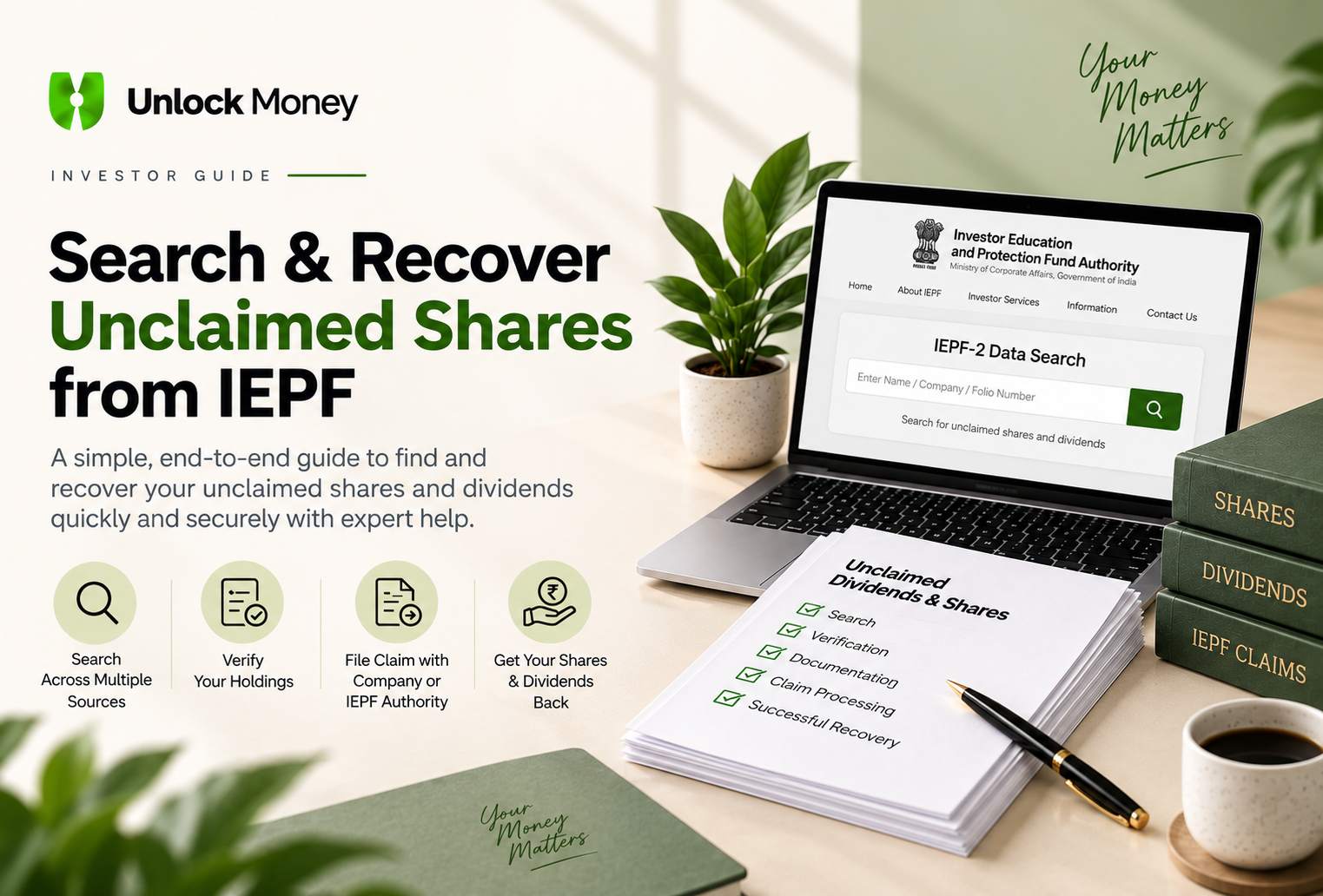
Method 1: Search on the Official IEPF Portal
The Ministry of Corporate Affairs maintains a public portal at iepf.gov.in where companies are required to upload data about shares transferred to IEPF. Here is how to navigate it.
1. Go to iepf.gov.in the official IEPF website maintained by the Ministry of Corporate Affairs.
2. On the homepage, look for the section labelled IEPF-2 Data Search or Investor Services. This is the database where company-uploaded shareholder data is stored.
3. On the search page, enter either your name as the shareholder, the company name, or the folio number if you have it. You can also filter by the PAN number in some company records.
4. Browse through the results. If your name or folio appears in the records for a company, your shares have been transferred to IEPF.
5. Note down the company name, folio number, number of shares, and unclaimed dividend amount shown in the record. This information will be needed for the recovery process.
Method 2: Check with the Company or Its RTA
Every listed company has a Registrar and Transfer Agent a SEBI-registered intermediary that maintains the company’s shareholder records. If you know which company’s shares you held, contacting the RTA directly is often faster and more reliable than searching the portal.
To find the RTA for a specific company, look up the company on BSE or NSE’s listed company directory. The RTA’s name and contact details are usually listed under the
investor relations section.
When you contact the RTA, provide your folio number or PAN to get a precise answer about the status of your shares. The RTA can confirm whether your shares have been transferred to IEPF and provide you with the relevant folio and transfer details.
Method 3: Check Through SEBI’s SCORES Portal or MCA21
If you are not sure which company’s shares you held, or if you want a broader picture of your investment history, you can also check via SEBI’s SCORES complaint portal or the MCA21 portal. While these are not designed specifically for IEPF transfer check queries, they can provide supporting information about a company’s filings and investor notifications.
Search Tip
Company records from the 1980s and 1990s were often entered manually and may have spelling variations. If a direct name search returns no results, try entering just the surname or a shortened version of the first name. You can also search by company name if you know which stock you held.
To make your IEPF transfer check as efficient as possible, gather the following information before you start. You may not need all of it, but having it ready will save time.
• Full name of the original shareholder exactly as registered with the company.
• Folio number from old dividend warrants, share certificates, or account statements.
• PAN card details of the original shareholder
• Name of the company or companies whose shares you are searching for.
• Any old physical share certificates, dividend receipts, or broker confirmation letters.
• In the case of deceased shareholders their death certificate and your relationship proof.
If you do not have all this information, do not worry. Unlock Money’s team is experienced at working with incomplete records and can often trace assets using just a name and an approximate time period.
Finding your shares in the IEPF system is only the first step. Recovering them is a separate and more involved process. Here is a brief overview of what the claim process looks like.
Filing IEPF Form 5
The official mechanism to claim shares from IEPF is through IEPF Form 5, available on the MCA portal at mca.gov.in. This form must be filled out carefully and submitted along with a set of supporting documents. Any errors or missing information can result in rejection and significant delays.
Documentation Required
The documentation requirements for an IEPF claim depend on the complexity of the case. A standard claim by a living original investor requires identity proof, address proof, demat account details, cancelled cheque, and original share certificates if available. Claims involving deceased shareholders require additional documents such as a death certificate, legal heir certificate, and in some cases a succession certificate obtained from a civil court.
Nodal Officer Verification
Once IEPF Form 5 is submitted, the claim is forwarded to a Nodal Officer appointed by the company whose shares are being claimed. The Nodal Officer verifies your documents and the claim details before forwarding everything to the IEPF Authority for final processing.
Credit to Demat Account
If the claim is approved, the shares are released from the IEPF Authority and credited to your demat account. The unclaimed dividends associated with those shares are also refunded via bank transfer. The entire process can take anywhere from three months to over a year, depending on the company’s responsiveness and the complexity of the case.
Common Rejection Reason
The most frequent cause of rejected IEPF claims is incorrect or incomplete documentation. A mismatch in name spelling between the form, the identity proof, and the company records is enough to delay or reject a claim. This is why professional guidance makes such a significant difference.
On paper, the steps to check and recover shares transferred to IEPF seem manageable. In practice, many people find the process frustrating, time-consuming, and full of bureaucratic obstacles. Here are the real-world challenges that trip people up.
Outdated Records
If the original shares were bought in the 1980s or 1990s, the company records may be in paper form, stored with a legacy RTA, or subject to data errors. Contact details, addresses, and even names may not match current documents, creating mismatch issues that require additional steps to resolve.
Dematerialisation of Physical Shares
If the shares are still in physical certificate form and were never converted to a demat account, dematerialisation must be completed before or alongside the IEPF claim. This involves submitting the original certificates to the RTA with a separate set of documents. If the certificates are lost or damaged, the process becomes significantly more complex.
Legal Complexity in Deceased Cases
When the original shareholder has passed away and the shares belong to their estate, the legal documentation required can be extensive. A succession certificate from a civil court is often mandatory, and the process of obtaining one can take months depending on the jurisdiction and workload of the court. Without professional help, many families give up at this stage.
Multiple Companies, Multiple Claims
Many older investors held shares in several companies. If shares have been transferred to IEPF from multiple companies, you need to file a separate IEPF Form 5 for each company and track each claim independently. Managing multiple claims simultaneously is something most individuals find overwhelming.
Follow-Up and Escalation
IEPF claims require active follow-up. If the Nodal Officer does not respond within the expected timeline, you need to know how to escalate either to the company’s compliance team or directly to the IEPF Authority. Without knowing the right contacts and processes, claimants can be left waiting for months without resolution.
Unlock Money is a specialised financial asset recovery service operated by AAPT Corp Advisors LLP. We exist to help individuals and families recover their unclaimed shares, dividends, and other financial assets from IEPF without the stress, confusion, and wasted time of doing it alone. Here is what we do for you.
Complete IEPF Transfer Check on Your Behalf
You do not need to navigate the government portal or contact multiple RTAs yourself. Share the name and basic details of the original shareholder with us, and our team will conduct a thorough search across the IEPF database, company records, and RTA systems. We will tell you exactly which shares have been transferred to IEPF, from which companies, and in what quantities.
Document Assessment and Preparation
Once we identify your claims, we assess the documentation required for each one and guide you through gathering exactly what is needed no more, no less. We prepare the documents, review them for accuracy, and ensure everything is correctly formatted before submission. This alone eliminates the most common reason for claim rejection.
End-to-End Claim Filing
We file IEPF Form 5 on your behalf and manage all correspondence with the Nodal Officer and the IEPF Authority. You do not need to track deadlines, follow up on pending responses, or decipher official correspondence. We handle all of that.
Deceased Shareholder Expertise
Our team has specific experience with cases involving deceased investors. We guide families through obtaining the right legal documentation, advise on whether a succession certificate is required for your specific case, and coordinate with courts, RTAs, and company compliance teams to keep the process moving.
Physical Share Certificate Handling
If the shares were originally held in physical form, we assist with the dematerialisation process alongside the IEPF claim. This ensures that once your claim is approved, the shares can be credited directly to your demat account without further delays.
Transparent Timelines and Regular Updates
We keep you informed at every stage of the process. You will always know what has been submitted, what is pending, and what to expect next. There are no vague responses or unexplained delays on our end.
Our Approach
At Unlock Money, we only take on cases where we genuinely believe recovery is possible. We assess each case honestly before you commit, so you always make an informed decision. No false promises, no surprise fees.
You do not need to have a specific reason to check. But these situations make it especially important to verify whether your shares have been transferred to IEPF.
• You or a family member held shares in the 1980s or 1990s and have not tracked them since
• You have received a letter from a company or RTA asking you to update your KYC or contact details
• You have received a notice from a company warning that your dividends will be transferred to IEPF
• A parent or grandparent has passed away and you are trying to understand their investments
• You have found old physical share certificates at home or among a deceased family member’s belongings
• You are an NRI who had Indian investments before moving abroad and has not checked them in years
• You previously tried to update your demat account details and received an error or no response.
Even if none of these situations apply directly, it is worth doing a basic IEPF transfer check every few years as part of general financial housekeeping. You might be surprised at what turns up.
Consider this typical situation. A family in Lucknow discovers old share certificates among their father’s belongings after he passes away. The father had bought shares in a public sector company in 1993 and had never converted them to demat. Dividends had been going undelivered for years since the address on record was an old one
.
By the time the family does an IEPF transfer check, they find that both the accumulated unclaimed dividends and the underlying shares now worth several lakhs due to decades of appreciation have been transferred to IEPF. The family had no idea this wealth existed.
With the right professional support, all of it is recoverable. The shares were transferred to IEPF, not forfeited. The government is obligated to return them to the rightful heirs upon a successful claim.
This scenario plays out across India every day, with amounts ranging from a few thousand rupees to several crores. The common thread is that the wealth was always there it just needed someone to look for it.
How long does an IEPF transfer check take?
A basic search on the IEPF portal can be done in a few minutes if you have the right information. A thorough search by Unlock Money covering multiple companies and cross-referencing RTA records typically takes one to three business days.
Is there a fee to check if my shares are in IEPF?
The IEPF portal is free to access. Unlock Money’s initial search and assessment is carried out before any commitment on your part. You will know exactly what we found and what recovery will involve before deciding whether to proceed.
Can I recover shares even if the original shareholder is deceased?
Yes. As a legal heir, you are entitled to claim the shares and unclaimed dividends. The process requires additional documentation, but Unlock Money specialises in exactly these types of cases.
What if I have shares with multiple companies in IEPF?
Each company requires a separate IEPF Form 5 filing. Unlock Money manages all claims simultaneously and keeps each one on track, so you do not have to juggle multiple processes yourself.
What happens to the unclaimed dividends along with the shares?
When shares are transferred to IEPF, the associated unclaimed dividends are also transferred. When your claim is approved, both the shares and the dividends are returned to you the shares go into your demat account and the dividends are transferred to your bank account.
Checking whether your shares have been transferred to IEPF is one of the most valuable things you can do for your financial health and it costs nothing to find out. The IEPF portal gives you a starting point, but a thorough check requires the right knowledge, the right information, and often the right professional support.
Unlock Money takes the complexity out of the process. From the initial IEPF transfer check to the final credit of shares to your demat account, our team manages everything so you can focus on what matters most. Whether you are checking for yourself, a parent, or a grandparent’s estate, we are here to help you recover what is rightfully yours.
Do not leave your money in a government account any longer than necessary. Contact Unlock Money today for a thorough IEPF transfer check and take the first step toward recovering shares that may have been waiting for you for years.
Do not hesitate to contact us. We’re a team of experts ready to talk to you.