


–
July 8, 2026
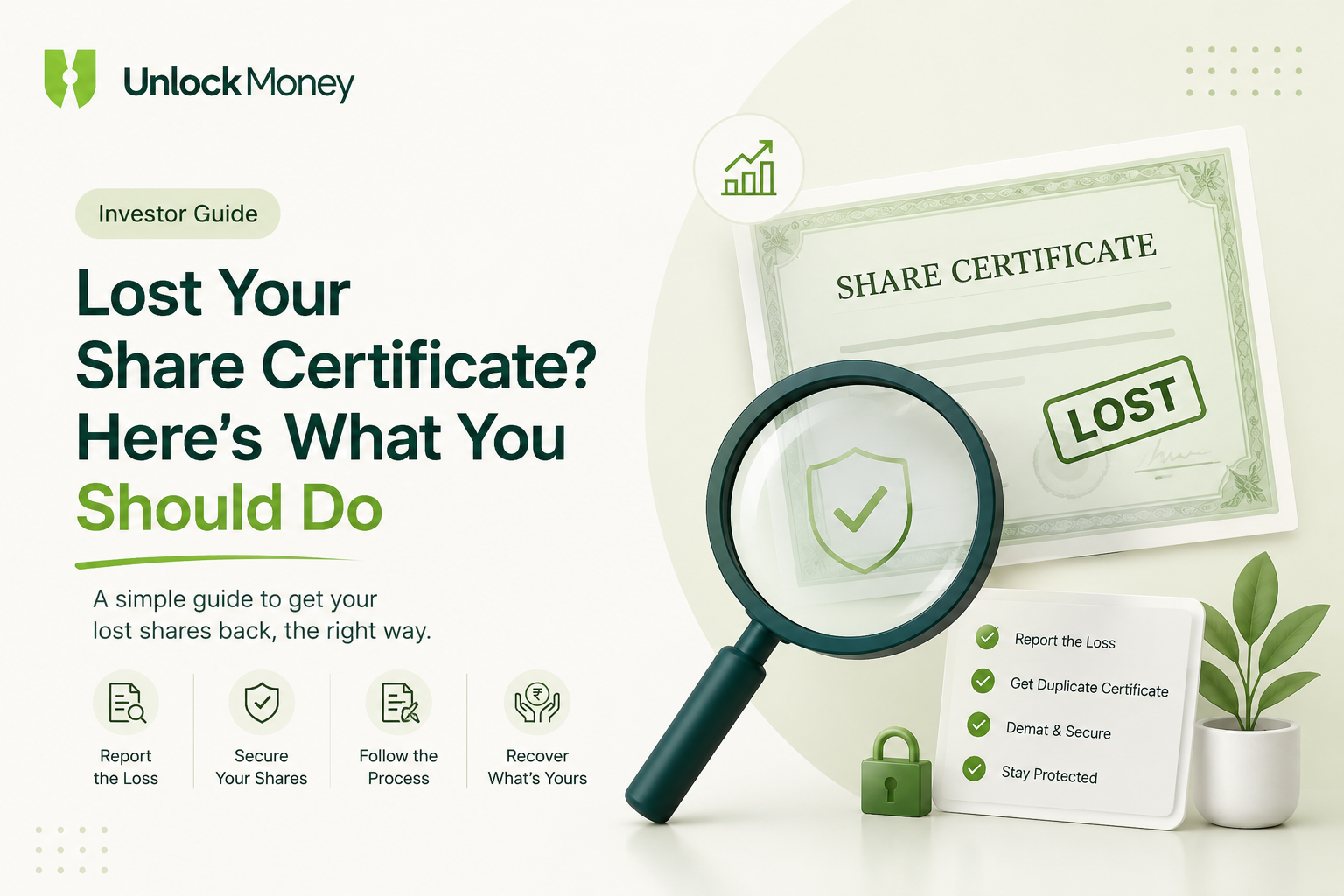
Finding out that your share certificate is lost can feel like a serious financial setback. Whether you discovered it while going through old papers, realised you cannot find it when you wanted to convert your holdings to demat, or inherited a set of investments from a family member with documents missing a lost share certificate is one of the most common financial problems Indian investors face.
Here is the most important thing to understand right away: a lost share certificate does not mean lost shares. Your ownership of those shares is not tied to the physical paper. It is recorded in the company’s shareholder register. The certificate is evidence of ownership but losing the evidence does not mean you have lost what it points to.
There is a legal, well-established process for replacing a lost share certificate with a duplicate, which then allows you to either trade, transfer, or dematerialise those shares. The process requires careful documentation, coordination with the company’s Registrar and Transfer Agent (RTA), and in some cases, legal undertakings but it is entirely manageable with the right guidance.
At Unlock Money, we help investors and families across India recover their position when share certificates are lost, damaged, or simply unaccounted for. This guide walks you through everything from what to do immediately to how the full duplicate share certificate process works and how we support you through it.
Key Reassurance
A lost share certificate does not mean your shares are gone. The company’s shareholder register is the definitive record of ownership. Your name still appears there. What you need is a duplicate certificate to re-establish documentary proof and that process exists specifically for this situation.
It might be tempting to leave the matter alone, especially if the shares feel like a distant memory or you are not planning to sell anytime soon. But there are several important reasons why resolving a lost share certificate situation sooner rather than later is in your best interest.
You Cannot Dematerialise Without a Certificate
SEBI regulations require physical share certificates to be submitted to your Depository Participant (DP) when converting physical shares to demat. Without the original certificate or a valid duplicate the dematerialisation process cannot begin. Since SEBI now mandates demat form for any transfer or trading activity, an unresolved lost effectively freezes your ability to do anything with those shares.
Dividend Payments May Be Blocked or Going Unclaimed
If your registered contact details with the company are outdated which is common with old share certificates dividend payments may be failing to reach you. These unpaid dividends accumulate in the company’s Unpaid Dividend Account. After seven years, the dividends and the underlying shares are transferred to IEPF. Acting on a lost share certificate situation early prevents this cascade from happening and keeps your assets accessible.
Shares Could Be Vulnerable to Fraud
If a physical certificate has been lost and not reported, there is a theoretical risk however small that it could be misused. Reporting the loss to the company and the RTA formally protects you. The company places a stop transfer notice against the folio, which prevents any fraudulent lodging of the certificate for transfer without your knowledge.
Old Share Certificates Represent Real Value
Many old share certificates relate to companies that have grown substantially over the decades. Shares bought in the early 1990s in blue-chip Indian companies may have appreciated by thousands of percent, with additional value added through bonus issues and stock splits. The certificate sitting forgotten in a drawer or no longer.
The moment you realise a share certificate is lost whether it has been misplaced, stolen, or damaged beyond use there are several steps you should take promptly to protect your position.
Step 1: Inform the Company and Its RTA
Your first call should be to the company’s Registrar and Transfer Agent. Every listed company has an RTA a SEBI-registered intermediary that manages the shareholder register and processes all share-related requests. You can find the RTA for any listed company through the company’s investor relations page, or through the BSE or NSE listed company directory.
Inform the RTA that the certificate for your folio has been lost and request that a stop transfer notice be placed against your folio immediately. This prevents anyone from presenting the lost certificate for transfer or any other transaction in your name without your authorisation. Most RTAs will act on this request quickly once you provide your folio number and identity details.
Step 2: File a Police Report
If the certificate was stolen or if you are not sure whether it was lost or stolen file a First Information Report (FIR) at your local police station. The FIR is a required document in the duplicate share certificate process for most companies. If the circumstances of the loss are clearly non-criminal such as a document lost during a house move or a certificate damaged beyond legibility some companies accept a non-traceable certificate instead of an FIR. The RTA will advise you on which is appropriate for your case.
Step 3: Gather What Information You Can
Before initiating the duplicate certificate process, gather everything you can that relates to the original certificate. This includes:
• The folio number (often printed on dividend warrants, contract notes, or old broker statements).
• The company name and the approximate number of shares held.
• The original share certificate number if visible in any old records.
• Any dividend warrants, annual report communications, or shareholder notices that confirm your holding.
• Your PAN card and current identity and address proof
Even partial information helps. The RTA can often trace your folio using just your name and PAN if the folio number is not available.
For Inherited Certificates
If you are dealing with old share certificates that belonged to a deceased parent or grandparent and cannot be found, the situation is more complex but equally resolvable. You will need both the duplicate certificate process and the transmission process transferring ownership from the deceased’s name to yours as legal heir. Unlock Money handles both together.
Investors facing documentation issues can seek help through our share recovery services.
Once the immediate protective steps are in place, you can begin the formal duplicate share certificate process. Here is how it works from start to finish.
1. Execute an Indemnity Bond
The indemnity bond is a legal document in which you undertake to indemnify the company against any future claim arising from the lost original certificate. In other words, you are telling the company: if the original certificate ever surfaces and someone else tries to use it, I will be responsible for any resulting liability. The indemnity bond must be executed on stamp paper of the appropriate denomination the required value varies by company and state and must be witnessed or notarised as required by the RTA.
The language and format of the indemnity bond must match what the specific company and its RTA require. Using a generic format without verifying the RTA’s requirements is a common source of rejection and delay.
2. Execute a Surety Bond or Provide a Guarantor
Many companies also require a surety bond alongside the indemnity bond for duplicate share certificate requests above a certain value. A surety bond involves a third party typically a creditworthy individual or a bank who guarantees your claim. Some RTAs accept a bank guarantee in place of a personal surety. The requirement varies significantly by company and share value, so confirming this with the RTA upfront
avoids unexpected delays.
3. File a Police FIR or Non-Traceable Certificate
As mentioned, most companies require either a police FIR (for stolen certificates) or a letter from the police confirming the certificate was reported but cannot be traced (for lost certificates). This document is submitted as part of the application package to the RTA. The FIR must specifically mention the share certificate number, the company name, and the folio number where possible.
4. Publish a Public Notice in a Newspaper
Most companies require the shareholder to publish a public notice in at least one widely circulated national newspaper and one regional newspaper, announcing the loss of the share certificate and inviting objections. The notice should include the certificate number, folio number, company name, and number of shares. After a waiting period typically fifteen to thirty days during which no objection is received, the company proceeds with issuing the duplicate.
The newspaper requirement is a safeguard for the company. It ensures that if anyone has the original certificate and believes they have a legitimate claim to it, they have an opportunity to raise an objection before a duplicate is issued.
5. Submit the Full Application to the RTA
Once the above documents are ready, compile and submit the complete package to the RTA. The application package typically includes:
• A formal written request letter for the duplicate share certificate.
• Copy of the FIR or non-traceable certificate from the police.
• Original executed indemnity bond on stamp paper.
• Surety bond or bank guarantee if required.
• Newspaper clippings showing the public notice.
• Copy of your PAN card, Aadhaar card, and address proof.
• Any supporting documents confirming the original holding, such as old dividend warrants or broker statements.
The RTA reviews the application and, if satisfied, instructs the company to issue a duplicate certificate. The original certificate even if found later is automatically rendered void once a duplicate is issued.
6. Receive the Duplicate Certificate and Proceed to Demat
Processing time for a duplicate share certificate request typically ranges from four to eight weeks after the complete application is accepted by the RTA. Once issued, the duplicate certificate carries the same legal standing as the original and can be submitted for dematerialisation through your Depository Participant in the standard way. At this point, you can convert physical shares to demat, and the shares will be credited
to your demat account electronically. From there, they can be held, sold, gifted, or transferred as you choose.
Timeline Expectation
The complete journey from reporting a lost share certificate to receiving the duplicate and completing dematerialisation typically takes three to five months for a straightforward case. Cases involving deceased shareholders, damaged documents, or companies that have merged or been restructured may take longer. Unlock Money sets accurate expectations upfront so you are never left guessing.
No two lost share certificate cases are identical. Here are the most common complications and what they mean for your recovery path.
The Company Has Merged or Been Acquired
Many companies that issued physical certificates in the 1980s and 1990s have since merged with other entities, been renamed, or been delisted. In these cases, the original RTA may no longer exist or may have transferred records to a new custodian. Tracing the current RTA and understanding how the corporate restructuring has affected your shareholding requires careful research.Unlock Money handles this tracing as a
standard part of our assessment process
.
The Certificate Is Damaged Rather Than Lost
A damaged or illegible certificate one affected by water, fire, pest damage, or simple deterioration requires a slightly different approach from a fully lost certificate. Most RTAs will accept a damaged certificate in lieu of an FIR, but they may require the certificate to be surrendered as part of the replacement process. The indemnity and surety bond requirements still apply. Our team assesses the condition of the certificate
and advises the most appropriate route.
Multiple Certificates Are Missing
If a family holds shares across several companies and certificates for multiple companies are missing, each company requires its own separate application with the respective RTA. The documentation requirements are similar across companies but not identical each RTA has specific format requirements for the indemnity bond, the request letter, and the surety arrangement. Managing multiple applications simultaneously, each at a different stage, is a significant undertaking without professional support.
The Original Shareholder Has Passed Away
When the certificate belonged to a deceased person, the legal heir must establish their right to the shares before a duplicate can be issued. This involves the transmission process which requires a death certificate, legal heir certificate, and in many cases a succession certificate from a civil court running in parallel with the duplicat certificate application. Done correctly, both processes can be coordinated so that the shares are transmitted to the heir’s name and dematerialised simultaneously, without needing separate rounds of paperwork.
The Shares Have Been Transferred to IEPF
If dividends linked to the lost certificate’s folio went unclaimed for seven years before the loss was reported, the shares may have already been transferred to IEPF. In this scenario, the duplicate certificate process is less relevant the shares are no longer in the company’s register but are held by the IEPF Authority. Recovery requires filing IEPF Form 5 rather than a duplicate certificate request. Unlock Money checks the IEPF status of any folio as part of its initial assessment, so clients do not pursue the wrong process.
Unlock Money is a specialised financial asset recovery service operated by AAPT Corp Advisors LLP. We have worked with hundreds of cases involving lost share certificates ranging from single certificates with clear documentation to complex multi-company situations involving deceased shareholders, damaged records, and IEPF transfers.
Here is what our involvement looks like in practice.
Initial Assessment and IEPF Check
We begin every case with a thorough check of the folio’s current status including whether the shares are still in the company’s register or have already moved to IEPF. This determines which process is appropriate and prevents clients from investing time in a duplicate certificate application when an IEPF claim is actually what is needed.
RTA Identification and Stop Transfer Placement
We identify the correct RTA for each company including in cases where the company has changed, merged, or been delisted and coordinate the placement of a stop transfer notice on your behalf. This protects your folio immediately while the longer application process is underway.
Document Preparation and Legal Coordination
We prepare every document in the application package the indemnity bond, surety bond, request letter, and accompanying proofs to match the specific requirements of each RTA. We coordinate with notaries and stamp paper providers, advise on surety arrangements, and manage the newspaper publication process. Everything is verified for accuracy before submission.
Transmission and Demat Coordination for Deceased Shareholder Cases
For cases involving deceased shareholders, we manage the transmission process alongside the duplicate certificate application. We advise on whether a succession certificate is necessary for your specific situation, assist with obtaining it where needed, and coordinate all submissions so that the share transfer, duplicate issuance, and dematerialisation happen in sequence without unnecessary gaps.
IEPF Claim Filing Where Required
When a folio’s shares have already moved to IEPF, we file IEPF Form 5 on your behalf and manage the entire claim process from Nodal Officer verification to final IEPF Authority approval and demat credit. Regular Updates and Follow-Up We track every application and follow up with RTAs and companies on your behalf when responses are overdue. You receive regular updates throughout the process so
you always know what stage your case is at and what is happening next.
Our Commitment to You
We take on cases we believe in. Before you commit to our service, we give you an honest assessment of what is involved, what is recoverable, and how long it is likely to take. No inflated promises, no unexplained costs.
Lost share certificate situations are more common than most people realise. Our service is designed for anyone in the following situations.
• Investors who have searched for an old share certificate and cannot find it at home.
• Families going through a deceased parent or grandparent’s belongings and finding incomplete sets of share documents.
• People whose certificates were damaged by water, fire, or general deterioration and are no longer legible.
• Shareholders who want to dematerialise their physical holdings but cannot locate all their certificates.
• Legal heirs who need to recover shares in a deceased person’s name but the original documentation is partly or fully missing.
• NRIs who left physical share certificates behind in India and are now trying to address them from abroad.
• Investors who received a notice from a company or RTA about impending IEPF transfer and cannot find the relevant certificates.
If you are in any of these situations, the right move is to start with an assessment. Bring us what you have, and we will tell you what is possible and what the path forward looks like.
Does losing a share certificate mean I have lost my shares?
No. Share ownership is recorded in the company’s shareholder register, not in the physical certificate. The certificate is documentary evidence of that ownership. Losing the certificate does not affect your ownership it only means you need to obtain a duplicate before you can transact with those shares.
What is the cost of getting a duplicate share certificate?
The costs involved include stamp paper for the indemnity bond, newspaper advertisement fees, any applicable government or company processing charges, and professional fees if you engage a service provider. The total varies by company and the complexity of the case. Unlock Money outlines all likely costs as part of your initial assessment.
How long does the duplicate share certificate process take?
From the date of submitting a complete application to the RTA, the process typically takes four to eight weeks for straightforward cases. Cases involving deceased shareholders, companies that have restructured, or multiple missing certificates may take longer. Our team gives you a realistic timeline based on your specific situation at the outset.
Can I claim dividends that went unclaimed while my certificate was lost?
Yes, if those dividends are still within the company’s Unpaid Dividend Account or have been transferred to IEPF, they remain recoverable. Unlock Money checks dividend status as part of our assessment and includes dividend recovery in our service where applicable.
What if the company no longer exists?
If the company has merged or been restructured, the shares may have been converted to shares in the successor company. The RTA records typically follow the restructuring. Unlock Money traces the current custodian of your shares regardless of corporate changes and initiates the appropriate process from there.
Can Unlock Money handle the entire process without me being present?
For most of the process, yes. We prepare documents, coordinate with RTAs, manage newspaper publications, and follow up on applications on your behalf. Some steps such as signing the indemnity bond or providing original identity documents will require your personal involvement, and we will guide you clearly on exactly what is needed and when.
A lost share certificate is a problem, but it is a solvable one. The process of obtaining a duplicate share certificate is formal and requires careful documentation but it exists precisely for this situation, and thousands of investors in India go through it successfully every year. The key is knowing the correct steps, preparing the right documents, and coordinating with the right parties at the right time.
Unlock Money takes every one of those responsibilities on your behalf. Whether you are dealing with a single lost certificate for a company you held shares in decades ago, or managing a complex situation involving deceased shareholders, multiple missing certificates, and potential IEPF transfers, our team handles the full process from the first stop transfer notice to the final demat credit.
Do not let a missing piece of paper stand between you and the value of your investments. Reach out to Unlock Money today for an initial assessment, and let us help you recover your shares the right way.
Do not hesitate to contact us. We’re a team of experts ready to talk to you.