


–
July 7, 2026
Somewhere in a drawer, a file, or an old steel almirah, millions of Indian families have physical share certificates that have not been touched in years. Some of these certificates belong to investors who are still alive and simply forgot about them. Many belong to parents and grandparents who passed away without ever telling their families what they held.
If you have found old share certificates or if you know you hold shares in physical form converting them to a demat account is one of the most important financial steps you can take right now. The process is called dematerialisation of shares, and it is the only way to fully unlock the value of your physical holdings in today’s market.
At Unlock Money, we help investors across India navigate the physical share conversion process ncluding complicated cases involving lost certificates, deceased shareholders, and shares already transferred to IEPF. This guide covers everything you need to know, from what physical shares are and why they need to be converted, to exactly how the dematerialisation process works and how we make it easier for you.
Why Act Now?
SEBI has made dematerialisation mandatory for transferring or trading physical shares.
If your physical certificates are left unconverted, you cannot sell them, transfer them, or
receive future dividends electronically. Converting them to demat is the only way to
make these assets fully usable and legally compliant.
Before India’s electronic depository system was established in the mid-1990s, all share ownership was evidenced by physical certificates printed documents issued by the company that stated the shareholder’s name, the number of shares held, and the folio number. These certificates were the legal proof of ownership and had to be held securely by the investor.
The National Securities Depository Limited (NSDL) was established in 1996 and the Central Depository Services Limited (CDSL) in 1999. Together, they introduced the concept of holding shares in electronic form through a demat account the same way a bank holds money in a savings account. Since then, the Indian market has progressively shifted to demat, and physical certificates are no longer issued for new share purchases.
However, tens of millions of physical certificates issued before this transition still exist in Indian homes. Many of these relate to shares in major companies Tata, Reliance, ONGC, Infosys, and other blue chips that have appreciated enormously since they were originally issued. The challenge is that these certificates cannot be sold or transferred without first completing the physical shares to demat conversion process.
The urgency around converting physical shares to demat has increased significantly in recent years. Here is why this matters more today than it ever did before.
SEBI’s Mandatory Dematerialisation Rule
The Securities and Exchange Board of India (SEBI) issued a circular making it mandatory for shareholders to hold shares in demat form for any transfer, pledge, or Physical share certificates can no longer be lodged with a company for transfer in the traditional sense. If you want to do anything with your physical shares sell them, gift them to a family member, or include them in an estate transfer dematerialisation is not optional. It is required.
Risk of Loss, Theft, and Damage
Physical certificates are vulnerable in ways that electronic holdings are not. Fire, flood, theft, pest damage, and simple deterioration over decades can destroy a certificate entirely. A damaged or illegible certificate creates significant complications during the conversion process and may require a lengthy duplicate certificate procedure. Holding shares in demat form eliminates this risk completely.
Dividend Payments and Corporate Actions
Companies increasingly process dividend payments, bonus share allotments, rights issues, and other corporate actions through demat accounts linked to verified PAN and bank details. Shareholders holding physical certificates may miss out on timely dividend credits, rights entitlements, and bonus share allotments because their registered details are outdated or because the company cannot process the action against a physical folio that lacks current KYC information.
Transparency and Portfolio Visibility
When shares are held in demat form, you have complete visibility over your portfolio in one place your demat account. You can track current market value, receive corporate action notifications, and manage your holdings with ease. Physical certificates offer none of this. Many investors do not even know how much the shares they hold are worth because they have never had the means to check conveniently.
IEPF Transfer Risk
If dividends linked to physical share holdings go unclaimed for seven years, the dividends and the underlying shares are transferred to IEPF. Once in IEPF, recovering them requires a formal claim process that is significantly more complex than a straightforward dematerialisation. Converting physical shares to demat early before the seven-year threshold is crossed is often the simplest way to prevent IEPF transfer entirely.
The Value Hidden in Old Certificates
Many physical certificates represent shares in companies that have grown significantly since they were issued. A certificate for 100 shares bought in 1995 at Rs 10 each could represent shares worth lakhs today after decades of price appreciation, stock splits, and bonus issues. You cannot access that value without completing the physical share conversion.
Investors facing documentation issues can seek help through our share recovery services.
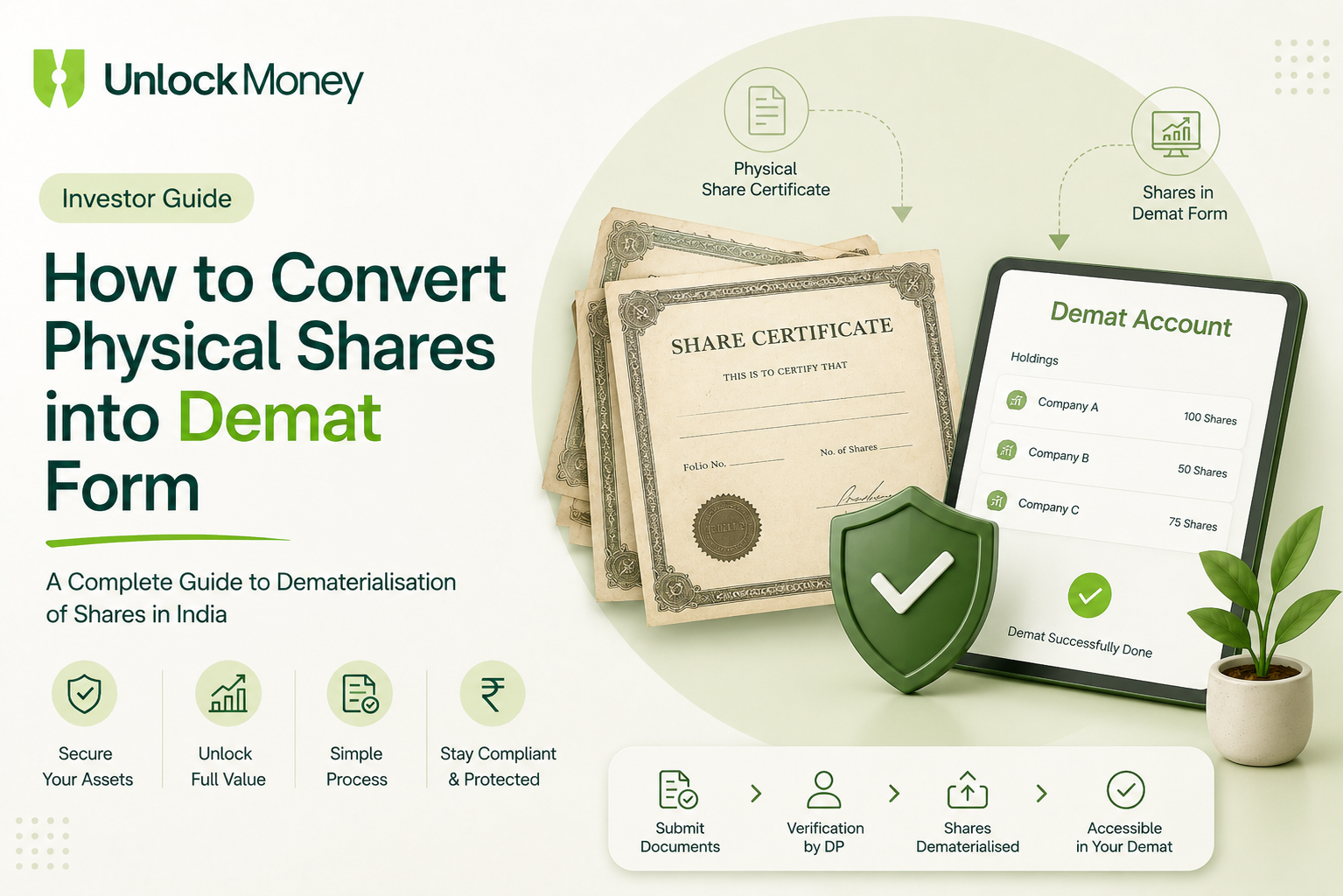
The dematerialisation of shares is a formal process regulated by SEBI and managed through your Depository Participant (DP) typically a bank or stockbroker registered with NSDL or CDSL. Here is how it works from start to finish.
Step 1: Open a Demat Account
If you do not already have a demat account, the first step is to open one with a SEBI registered Depository Participant. You will need your PAN card, Aadhaar card, a passport-sized photograph, a cancelled cheque, and proof of address. The account opening process typically takes two to five business days. Most leading banks and discount brokers offer demat account opening services online.
If you are converting shares on behalf of a deceased person, the demat account must be opened in the name of the legal heir or the estate, depending on the specifics of the case.
Step 2: Fill the Dematerialisation Request Form
Once your demat account is active, you need to obtain a Dematerialisation Request Form (DRF) from your DP. This form captures the details of the shares you want to convert the company name, the ISIN (International Securities Identification Number), the folio number, and the number of shares. Each company’s shares require a separate DRF, so if you are converting shares from multiple companies, you will need one form per company.
Step 3: Deface the Physical Certificates
Before submitting the physical certificates with the DRF, you must deface them by writing ‘Surrendered for Dematerialisation’ across the face of each certificate. This is a mandatory step that prevents the certificate from being presented again as proof of ownership once it has been converted to electronic form.
Step 4: Submit to Your DP
Submit the defaced physical certificates along with the completed DRF to your DP. The DP will verify the form and the certificates, generate a Dematerialisation Request Number (DRN), and forward the request to the company’s Registrar and Transfer Agent (RTA) through the depository system.
Step 5: Verification by the RTA and Company
The RTA verifies the authenticity of the certificates, checks the folio details, and confirms the number of shares. Once the verification is complete, the RTA instructs the depository to credit the shares to your demat account electronically. The physical certificates are then cancelled and destroyed by the RTA.
Step 6: Shares Credited to Your Demat Account
The entire process from submission to credit typically takes fifteen to thirty days for standard cases. Once credited, the shares appear in your demat account and can be traded, transferred, or held as you choose.
Important Check
Before submitting your certificates, verify the ISIN for each company’s shares. ISINs are
available on the BSE or NSE website and on the NSDL or CDSL website. Submitting a
DRF without the correct ISIN can delay the processing.
This is one of the most common complications in physical share conversion, and it is a situation that Unlock Money handles regularly. If your certificate is lost, stolen, or damaged beyond legibility, you cannot submit it for standard dematerialisation. Instead, you must first obtain a duplicate certificate from the company before the demat process can proceed.
Procedure for Obtaining a Duplicate Certificate
1. File a First Information Report (FIR) at your local police station if the certificate was stolen. For lost certificates, some companies require a non-traceable report instead.
2. Execute an indemnity bond and an affidavit on stamp paper. The indemnity bond holds the company harmless against any future claim arising from the original certificate, and the affidavit confirms the circumstances of the loss.
3. Advertise the loss of the certificate in a national newspaper. Some companies require this as an additional precautionary step before issuing a duplicate.
4. Submit the FIR or non-traceable report, indemnity bond, affidavit, newspaper advertisement, and a copy of your PAN and identity proof to the company’s RTA with a formal written request for a duplicate certificate.
5. The RTA processes the request which can take four to eight weeks and issues a duplicate certificate marked as such.
6. Once the duplicate certificate is in hand, you can proceed with the standard DRF submission process for dematerialisation.
This process requires precision. Any inconsistency between the indemnity bond, the affidavit, and the company’s records can delay or reject the duplicate certificate request. Many families attempting this alone find themselves going back and forth with the RTA for months.
A large proportion of physical share certificates in India belong to investors who are no longer alive. When the original shareholder has passed away, the dematerialisation process requires an additional step called transmission the legal transfer of the shares from the deceased’s name to the name of the legal heir — before or alongside the demat conversion.
What Transmission Involves
Transmission is governed by the Companies Act and SEBI regulations and requires the legal heir to establish their right to the shares. The documents required depend on whether a nominee was registered with the company and the value of the shares involved.
For smaller holdings where a nominee is registered, the process is relatively straightforward the nominee submits a transmission request to the RTA with a death certificate, identity proof, and a request letter.
For larger holdings or cases without a registered nominee, the legal heir typically needs a succession certificate issued by a civil court, a probate order if there is a will, or a legal heir certificate. These are formal legal documents that establish the claimant’s right to the deceased’s assets and are required by the RTA and the depository before shares can be transferred.
Combined Transmission and Dematerialisation
In practice, transmission and dematerialisation can often be handled simultaneously rather than sequentially. The legal heir opens a demat account in their own name, submits the transmission request along with the DRF and all required documents to the RTA, and the RTA processes both the transmission and the demat credit together. This combined approach saves several weeks compared to doing them separately.
However, this requires careful coordination between the DP, the RTA, and the depository and any document error can cause the entire process to be rejected andrestarted. This is one of the most complex scenarios in physical share conversion, and it is where professional guidance makes the biggest practical difference.
Legal Heir Cases
If you have found physical share certificates belonging to a deceased parent or
grandparent, do not attempt to act on them without first establishing your legal right to
do so. Submitting a DRF without proper transmission documentation can result in
rejection, flagging of the account, and significant delays in eventual recovery.
Physical share certificates and IEPF claims are closely connected and understanding this connection can save you significant time and effort.
When dividends linked to a physical share holding go unclaimed for seven years, both the dividends and the shares are transferred to IEPF. At that point, the physical certificate the investor holds is technically no longer valid the company has already transferred the beneficial ownership of those shares to the IEPF Authority.
To recover shares that have moved to IEPF, you must file IEPF Form 5 with the MCA portal. The claim process requires you to have a demat account, since IEPF releases shares only in electronic form. This means that even if shares have moved to IEPF, converting physical shares to demat or opening a demat account is still a prerequisite for completing the recovery.
Unlock Money handles this intersection routinely. When a client’s physical shares have partially moved to IEPF and partially remain eligible for standard dematerialisation, we manage both processes simultaneously the IEPF claim for the transferred portion and the DRF submission for the portion still eligible for direct conversion.
The standard dematerialisation process is manageable for a single certificate from a cooperative company when all your documents are in order. In practice, most cases involving physical share certificates are more complicated multiple companies, outdated KYC, damaged certificates, deceased shareholders, or shares already in IEPF. This is exactly where Unlock Money steps in.
Complete Document Assessment
We begin by reviewing the physical certificates and all available documentation to identify what is needed for each specific case. We flag potential issues name mismatches, incomplete folio details, missing endorsements, or certificate damage before submission, so nothing delays the process unnecessarily.
RTA Identification and Communication
Finding the correct RTA for each company especially for companies that have merged, been acquired, or changed their RTA over the years is a task that requires experience and access to up-to-date registrar information. We handle all RTA communication on your behalf, from the initial inquiry to the final credit confirmation.
Duplicate Certificate Facilitation
For lost or damaged certificates, we manage the complete duplicate certificate process the FIR, affidavit, indemnity bond, newspaper advertisement, and RTA submission. We know exactly what each RTA requires and prepare every document to match, minimising back-and-forth and rejection risk.
Transmission and Demat for Deceased Shareholders
Our team has extensive experience handling transmission cases — including those requiring succession certificates and probate orders. We guide families through the legal documentation process, coordinate with the civil court where necessary, and manage the combined transmission an dematerialisation submission to ensure the fastest possible resolution.
IEPF Claim Coordination
When physical shares have already moved to IEPF, we file the IEPF Form 5 claim alongside the demat account setup, so both processes move forward in parallel. This integrated approach avoids the common scenario where a client completes the demat account opening only to discover the shares are already in IEPF and need a separate process.
End-to-End Tracking and Updates
We track every submission, every verification step, and every pending response. You receive regular updates at each stage so you always know where your case stands. When there are delays or additional requirements from an RTA or company, we handle them immediately without waiting for you to chase anyone.
Unlock Money’s Approach
We assess every case before committing. If we identify challenges that make conversion complicated or unlikely to succeed without additional legal steps, we tell you clearly upfront. Our goal is to give you an accurate picture of what the process involves not to take on work we cannot complete.
Physical share conversion is relevant to a wide range of people across India.
• Investors who bought shares in the 1980s or 1990s and still hold physical certificates they have never converted.
• Families who discovered old share certificates while going through a deceased parent or grandparent’s belongings.
• People who have received communication from a company or RTA asking them to update their KYC or demat details.
• Shareholders who are unable to sell or transfer shares because they are held in physical form.
• Legal heirs who need to complete transmission and dematerialisation as part of settling an estate.
• NRIs who held Indian shares in physical form before moving abroad and have never addressed the conversion.
• Anyone who has received a notice warning that their shares are about to be or have been transferred to IEPF.
If any of these situations apply, the first step is to bring your physical certificates to us or share the details with our team for an initial assessment. We will tell you exactly what is involved, what can be recovered, and how long it is likely to take.
Can I sell my physical shares without converting them to demat?
No. SEBI regulations require shares to be held in demat form before they can be traded or transferred on stock exchanges. Physical certificates cannot be lodged for transfer in the traditional sense anymore. Dematerialisation of shares is mandatory before any sale or market transaction.
What if the company mentioned on my certificate no longer exists?
If the company has merged with another entity, been acquired, or been renamed, the shares may have been converted automatically through a corporate restructuring event. The resulting shares may be held by the successor company’s RTA. Unlock Money traces the current custodian of shares in these situations as part of our assessment process.
How long does the dematerialisation process take?
Standard cases with complete documentation typically take fifteen to thirty days from DRF submission to demat credit. Cases involving duplicate certificates, deceased shareholders, or IEPF claims take longer often three to six months. Our team gives you a realistic timeline based on your specific situation from the outset.
Is there a fee for dematerialisation?
DPs typically charge a nominal fee for processing dematerialisation requests, which varies by broker or bank. There may also be stamp duty and other incidental charges. Unlock Money will outline all applicable costs as part of your case assessment.
Can I convert shares of multiple companies at once?
Yes, but each company requires a separate Dematerialisation Request Form. Unlock Money manages simultaneous conversions across multiple companies, tracking each submission independently to ensure none are delayed or overlooked.
What if my name on the share certificate is slightly different from my current ID proof?
Name mismatches are common and need to be resolved before the RTA will process the DRF. Depending on the nature of the discrepancy, the solution may involve an affidavit explaining the variation, a name change certificate, or an updated identity document. We handle name mismatch cases as a routine part of our service.
Physical share certificates represent real, tangible wealth but only if you take the steps to convert them into a form that the modern financial system recognises and can act on. The process of converting physical shares to demat is well-defined, but it involves coordination across multiple parties, precise documentation, and an
understanding of how each company’s RTA operates.
Whether your certificates are in good condition or damaged, whether the original shareholder is still alive or has passed away, and whether the shares are still with the company or have already moved to IEPF Unlock Money has the expertise to manage your case from start to finish.
Do not let valuable shares sit as paper in a drawer. Reach out to Unlock Money today, and let our team help you unlock the full value of your physical holdings through a managed, professional dematerialisation process.
Do not hesitate to contact us. We’re a team of experts ready to talk to you.