


–
July 22, 2026
If you have been investing in Indian stocks for a while, you may have wondered whether you can open more than one demat account. Maybe you started with one broker and want to move to another without closing the first. Maybe you want to keep long-term holdings separate from active trading. Or maybe you inherited an old investment that is sitting in a demat account you no longer actively use and you are not sure what to do with it.
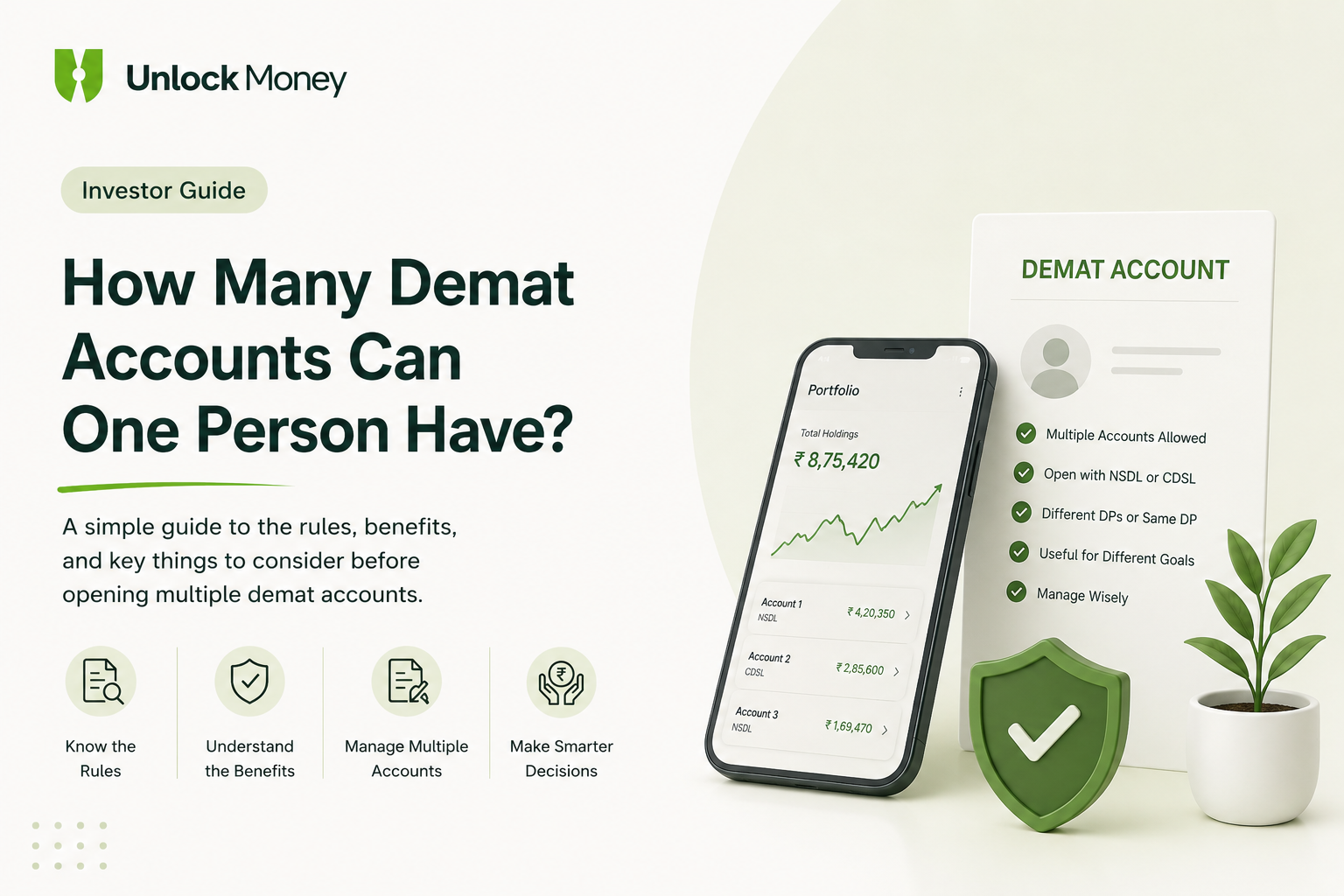
The short answer is: yes, you can hold multiple demat accounts in India. SEBI regulations allow a single investor to open and maintain more than one demat account, whether with the same Depository Participant or with different ones across NSDL and CDSL. There is no fixed upper limit on how many you can have.
But just because you can have multiple accounts does not automatically mean you should, or that managing them comes without complications. Understanding the rules around multiple demat accounts, the practical benefits and drawbacks, and how your demat account connects to important processes like IEPF share recovery is essential before making any decisions.
At Unlock Money, we work with investors across India who are navigating demat account complexities, especially in the context of recovering old shares, dealing with physical certificates, and managing the accounts of deceased family members. This guide covers everything you need to know about how many demat accounts one person can have and what the rules actually mean in practice.
A demat account, short for dematerialised account, is an electronic account that holds your financial securities in digital form. Just as a savings account holds money, a demat account holds shares, bonds, mutual fund units, government securities, and other financial instruments.
In India, demat accounts are maintained by two depositories: the National Securities Depository Limited (NSDL) and the Central Depository Services Limited (CDSL). You do not open a demat account directly with NSDL or CDSL. Instead, you open it through a Depository Participant (DP), which is a SEBI-registered intermediary such as a bank, stockbroker, or financial institution that acts as your interface with the depository.
The demat account is central to almost every investment-related process in India today. When you buy shares on a stock exchange, they are credited to your demat account. When you sell, they are debited. When a company credits bonus shares, they go into your demat. When you file an IEPF claim to recover unclaimed shares, the recovered shares are credited to your demat account. Without an active demat account, none of these processes can be completed.
IEPF Recovery Service India Investor Education and Protection Fund (IEPF) has been established under Section 205C of the Companies Act, 1956 through the Companies (Amendment) Act, 1999 to promote investor awareness and protect the interests of investors. Later, the IEPF Authority was constituted under Section 125(5) of the Companies Act, 2013 to administer the IEPF fund and facilitate the refund of shares, unclaimed dividends, matured debentures, deposits, and other financial assets to rightful investors while actively promoting investor education and protection.
Under current SEBI regulations and the rules governing NSDL and CDSL, there is no restriction on the number of demat accounts a single individual can hold. You can open multiple accounts with the same DP or with different DPs. You can also hold accounts with both NSDL-registered and CDSL-registered participants simultaneously.
The only real constraint is practical rather than regulatory: each demat account you open and maintain comes with its own set of charges, compliance requirements, and administrative responsibilities. Understanding these is what makes the difference between a sensible multi-account strategy and an unnecessary financial burden.
Can You Hold Accounts with Both NSDL and CDSL?
Yes. NSDL and CDSL are two separate and independent depositories in India. You can hold one demat account with an NSDL-registered DP and another with a CDSL registered DP. Many investors do this when they use different brokers, since some brokers are registered exclusively with one depository.
There is no requirement to consolidate or choose one. Your holdings across both depositories remain independently valid, and both accounts are recognised for the purposes of trading, IEPF claims, and corporate actions.
Can You Open Multiple Accounts with the Same DP?
This depends on the DP’s internal policies. Some Depository Participants allow a single investor to maintain more than one account with them, while others restrict each investor to one account. If your broker allows it, you might open separate accounts for different purposes, such as one for equity holdings and another for mutual fund units or bonds. Check directly with your DP for their specific policy.
There is no legal limit on how many demat accounts one person can hold in India. SEBI permits investors to maintain multiple accounts with different Depository Participants. However, each account carries its own charges, compliance requirements, and KYC obligations.
While the number of accounts is not capped, there are important demat account rules that apply when you hold multiple accounts. These rules are set by SEBI, the depositories, and the individual DPs.
KYC Is Required for Each Account
Every demat account requires a complete Know Your Customer (KYC) verification. This means each account must have your PAN, Aadhaar, address proof, photograph, and bank account details on file, and all of them must be current and verified. If your KYC details have changed and you hold multiple accounts, you need to update each one separately with the respective DP.
SEBI has also mandated that all demat accounts be linked to a verified mobile number and email address through a process called email and mobile updation. Failing to complete this for any of your accounts can result in the account being flagged or restricted.
Annual Maintenance Charges Apply to Each Account
Every demat account attracts an Annual Maintenance Charge (AMC), which is levied by the DP. AMC rates vary across DPs and account types, but a typical range is between Rs 300 and Rs 900 per year for a standard individual account. Some brokers offer zero AMC accounts, but these often come with conditions or higher transaction fees.
If you hold three demat accounts with three different DPs and each charges Rs 500 per year in AMC, you are spending Rs 1,500 annually just to maintain empty or barely used accounts. For accounts that hold minimal or no value, the AMC can quickly erode any benefit of keeping them open.
Nomination Is Required for Each Account
SEBI regulations require demat account holders to either register a nominee or submit a declaration opting out of nomination. This applies to every demat account independently. If you hold multiple accounts and have not completed nomination for all of them, the accounts may be frozen for debit transactions.
The nomination requirement became more stringent following SEBI’s 2022 circular, which set a deadline for all existing accounts to complete or opt out of nomination. Any account where nomination was not updated by the deadline was restricted. If you have old or inactive demat accounts you have not checked recently, it is worth verifying whether they are still active or have been frozen.
PAN Is the Common Identifier Across All Accounts
Your Permanent Account Number is the unique identifier that links all your demat accounts to your identity. Every demat account you open must be registered under your PAN. The PAN-linked account data is accessible to depositories, regulators, and income tax authorities. This means that all your demat holdings across all accounts are traceable under a single PAN, which has implications for tax reporting and compliance.
f you hold shares in multiple demat accounts and earn dividends or capital gains from any of them, all income must be reported in your income tax return. NSDL and CDSL make your demat account holdings data available to the income tax department through Annual Information Statement (AIS). Inactive accounts that receive corporate action credits, such as bonus shares, can create reporting obligations you may not be aware of.
There are several legitimate reasons why an individual might choose to maintain more than one demat account. Understanding these can help you decide whether multiple accounts make sense for your situation.
Switching Brokers Without Closing the Old Account
This is probably the most common reason investors end up with multiple demat accounts. When you switch to a new broker for better trading platforms, lower brokerage, or improved service, you open a new demat account with the new DP. Rather than going through the process of transferring all holdings and closing the old account, many investors simply start using the new account and leave the old one open with whatever holdings remain there.
Over time, this can result in holdings scattered across two or three accounts with different DPs, making it harder to get a clear picture of your total portfolio.
Separating Long-Term Holdings from Active Trading
Some investors deliberately maintain two demat accounts for different purposes. One account holds long-term equity investments that are rarely traded, often with a bank based DP for the stability and convenience of banking integration. A second account with a discount broker is used for active trading, where lower transaction costs and faster order execution matter more.
This is a valid strategy as long as you are comfortable managing the charges and compliance requirements of both accounts.
Holding Inherited Investments
When a family member passes away and their demat account holdings need to be transferred to a legal heir, the transmission process credits the inherited shares into theheir’s existing demat account. However, if the transmission is handled separately and a new account was opened specifically for the purpose, you can end up with an account that holds only the inherited shares alongside your regular account.
Old Accounts from Physical Share Conversion
Many investors who converted old physical share certificates to demat form did so through whatever broker was available at the time, often before they had an existing demat account with their preferred broker. The converted shares now sit in an account they do not regularly use.
This is a scenario Unlock Money encounters frequently. When families discover old physical certificates and go through the dematerialisation process or the IEPF claim process, the resulting shares are credited to a demat account that may not be the investor’s primary one. Consolidating these holdings is often the next sensible step.
While multiple demat accounts are permitted and sometimes useful, there are real downsides to holding more accounts than you actively need.
Ongoing Annual Maintenance Charges
As mentioned, each account carries its own AMC. If you have three accounts and only actively use one, you are paying charges on two accounts that serve no practical purpose. Over several years, this adds up to a meaningful cost, especially if you are unaware that the charges are being debited.
KYC and Nomination Compliance Burden
Every account must have current KYC and completed nomination. If your address, bank account, or contact details change, you need to update each account separately. Missing an update in one account can lead to it being frozen, which creates problems when you later need to access holdings in that account.
Fragmented Portfolio View
When your holdings are spread across multiple accounts, you lose the clarity of seeing your complete portfolio in one place. This makes it harder to track your total investment value, plan asset allocation, or make decisions about rebalancing. Many investors with multiple accounts are not fully aware of what they hold in each one.
Increased Risk of Forgotten Holdings
The more accounts you have, the easier it is to lose track of one. A demat account that is not regularly checked can accumulate uncredited dividends, unexercised rights, or bonus shares that you are entitled to but never notice. In the worst case, if the associated bank account or contact details become outdated, these credits can fail to reach you and potentially lead to the shares eventually being transferred to IEPF.
Many IEPF cases that come to Unlock Money originate from exactly this situation. An investor opened a demat account years ago to convert old physical shares, forgot about it, and the associated bank account became inactive. Dividends from those shares went unclaimed, and eventually the shares moved to IEPF. A simple annual check of all demat accounts would have prevented this entirely.
For most investors, holding more demat accounts than you actively use creates unnecessary cost and complexity. If you have holdings scattered across multiple accounts, consolidating them into a single primary account is usually the cleaner approach.
The process of transferring shares from one demat account to another is handled through an off-market transfer or a Delivery Instruction Slip (DIS). You instruct the source DP to transfer specified shares to the target demat account. There is typically a small transaction fee per transfer, and the process takes one to two business days. Once the transfer is complete, you can initiate account closure with the source DP.
Before closing any account, verify that it does not hold any pending corporate actions, dividend credits, or rights entitlements. Check the account statement carefully and contact the DP to confirm there are no outstanding credits or pending transactions before initiating closure.
There are situations where maintaining more than one demat account is genuinely useful rather than just convenient.
• You actively trade with a discount broker and separately hold long-term investments with a bank-based DP, and you have the discipline to manage both accounts.
• You are in the process of transferring inherited holdings to your primary account and need the secondary account temporarily.
• You are an HUF (Hindu Undivided Family) where the Karta holds a personal account and a separate HUF account, which are distinct legal entities.
• You are an NRI with different account types required for different investment categories under FEMA regulations.
In all other cases, fewer accounts tend to mean less cost, less compliance burden, and a clearer picture of your investment portfolio.
For anyone dealing with old investments, physical share certificates, or inherited assets, the question of how many demat accounts one can have is directly connected to the IEPF recovery process.
When you file an IEPF claim to recover unclaimed shares, the IEPF Authority credits the recovered shares to the demat account specified in your Form IEPF-5. This means you need to decide which of your demat accounts you want the shares credited to before you file the claim. Changing the account after submission requires resubmitting the form.
If you are a legal heir filing an IEPF claim on behalf of a deceased investor, the demat account for the credit must be in your own name. The IEPF will not credit shares to the deceased person’s demat account. This is another reason why having a clear, active demat account in your own name before initiating the claim process is important.
Unlock Money helps clients navigate this connection between their demat account setup and their IEPF recovery process. We ensure that the correct demat account details are entered in Form IEPF-5 and that the account is active, KYC-compliant, and capable of receiving the credit before the claim is filed.
Unlock Money is a specialised financial asset recovery service operated by AAPT Corp Advisors LLP. While our primary focus is IEPF share recovery and unclaimed investment recovery, demat account issues are an integral part of almost every case we handle.
Identifying the Right Demat Account for IEPF Claims
When clients have multiple demat accounts, we help them identify which account is the most appropriate to use for the IEPF credit. We verify that the account is active, that the KYC details are current, and that the bank account linked to it is operational so the dividend refund can also be credited without issues.
Assisting with Demat Account Opening
For clients who do not yet have a demat account, or who need to open one in the name of a legal heir before an IEPF claim can proceed, we guide them through the account opening process and the documentation required. We ensure the account is set up correctly before any claim is filed.
Managing Physical Share Dematerialisation
When old physical share certificates are part of the picture, we handle the complete dematerialisation process alongside the IEPF claim or dividend recovery process. This includes identifying the correct DP to use, preparing the Dematerialisation Request Form, and ensuring the resulting credit goes to the client’s designated primary demat account.
For families managing the financial estate of a deceased investor, demat account transmission and IEPF claim filing often need to happen together. We coordinate both processes so the legal heir’s demat account is ready to receive both the transmitted holdings from the deceased’s existing account and any IEPF credits from shares that had already moved to the government fund.
If you are unsure how many demat accounts you or a family member hold, start by searching under your PAN. NSDL’s IDeAS portal and CDSL’s easi portal both allow you to check all accounts linked to your PAN. This is the first step toward getting a complete picture of your holdings and identifying anything that needs attention.
Is there a maximum number of demat accounts one person can have in India?
No. SEBI does not impose a cap on the number of demat accounts an individual can hold. You can open accounts with multiple Depository Participants across NSDL and CDSL. The only practical constraints are the Annual Maintenance Charges, KYC obligations, and nomination requirements that apply to every account independently.
Can I hold demat accounts with both NSDL and CDSL at the same time?
Yes. NSDL and CDSL are independent depositories and there is no restriction on holding accounts with registered participants of both. Many investors maintain accounts with DPs registered under different depositories, particularly when they use multiple brokers.
Do I have to pay AMC for all my demat accounts?
Yes, each demat account is subject to its own Annual Maintenance Charge levied by the respective DP. Even if an account holds no shares, the AMC may still be applicable depending on the DP’s terms. Some DPs offer zero-AMC accounts, but these often come with higher transaction fees or minimum balance conditions.
Can I close a demat account that I no longer use?
Yes. You can close a demat account by submitting a closure request to your DP after transferring all remaining holdings to another account. The DP will close the account once the balance is nil and all pending transactions are settled. Ensure there are no outstanding charges or corporate action credits before initiating closure.
What happens to my demat account if I pass away?
If you have registered a nominee, the nominee can apply for transmission of the holdings to their own demat account by submitting the required documents to the DP. If no nominee is registered, the legal heir must provide a succession certificate or legal heir certificate. The account is not automatically closed upon the account holder’s death and continues to hold the securities until transmission is completed.
Does having multiple demat accounts affect my tax filing?
Yes. Income generated across all demat accounts, including dividends and capital gains, must be reported in your income tax return. The Annual Information Statement (AIS) available on the income tax portal aggregates data across all accounts linked to your PAN, so all activity is visible to the tax department regardless of how many accounts you hold.
Can I use any of my demat accounts for an IEPF claim?
Yes, but the account you specify in Form IEPF-5 must be in the claimant’s name, must be active, and must have current KYC. If you are a legal heir filing on behalf of a deceased investor, the demat account must be in your own name, not the deceased’s. Unlock Money.
Do not hesitate to contact us. We’re a team of experts ready to talk to you.