


–
August 20, 2026
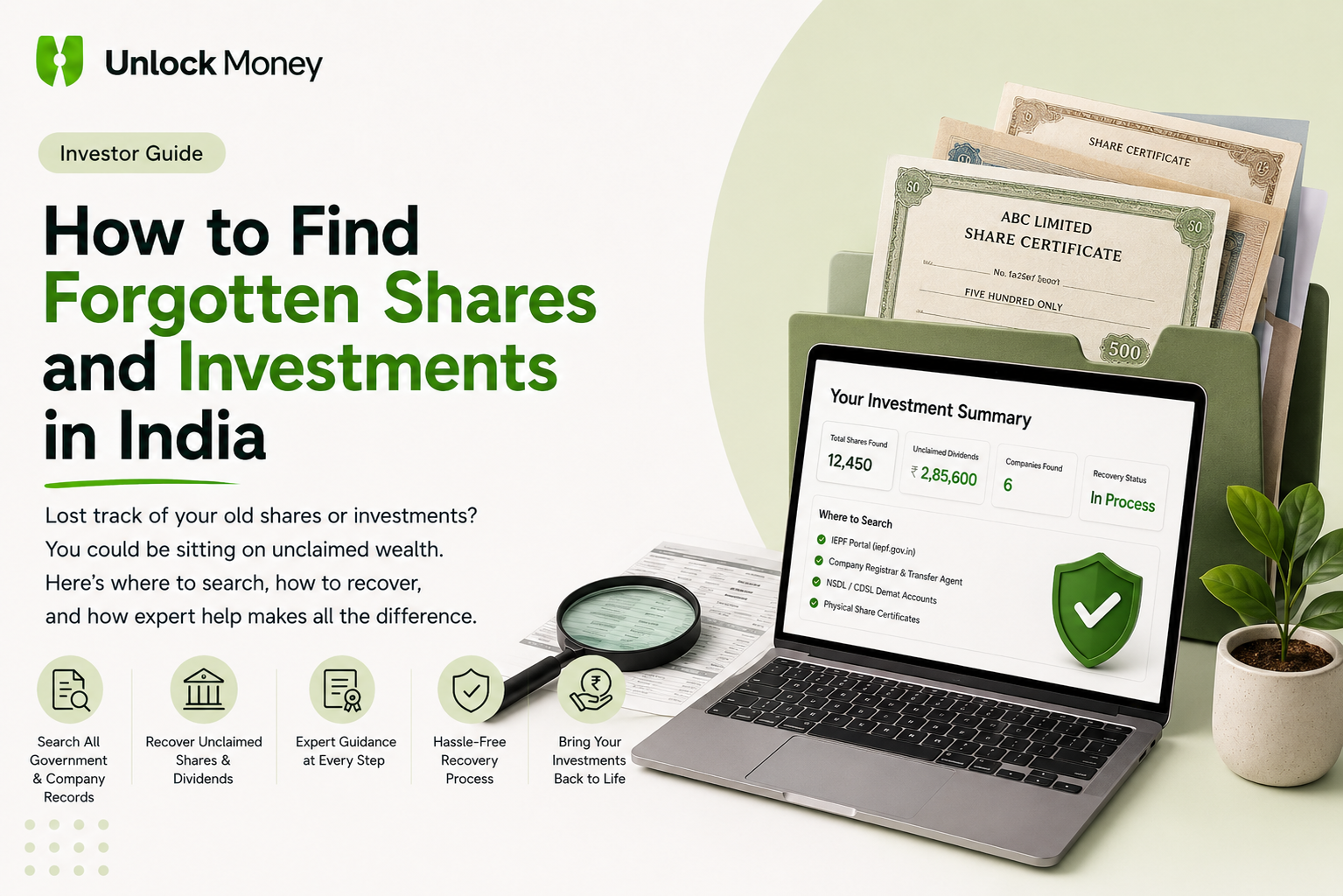
There is more forgotten investment wealth in India than most people realise. It sits in government databases, company registrar records, and physical certificates folded into files that have not been opened in a decade. It belongs to investors who changed banks, moved cities, or simply lost track of what they bought during the liberalisation era. It belongs to the families of investors who passed away without leaving a clear record of what they owned.
Finding forgotten shares and investments in India is entirely possible. Several government databases and company records are publicly accessible, and a systematic search across all of them can reveal holdings that investors had no idea still existed. The challenge is knowing which databases to check, what to search for, and how to interpret what the results mean for your specific situation.
This guide covers every place where forgotten shares can be found in India, how to search each source, what the results tell you, and what to do once you have found your investments. It also explains how Unlock Money helps individuals and families conduct these searches professionally, assess what is recoverable, and manage the complete process of bringing those investments back into an active demat account.
Before you can find shares, you need to know where they might be. Forgotten investments in India sit in one or more of the following places, depending on how long they have been inactive and what happened to the dividends associated with them.
The IEPF Portal
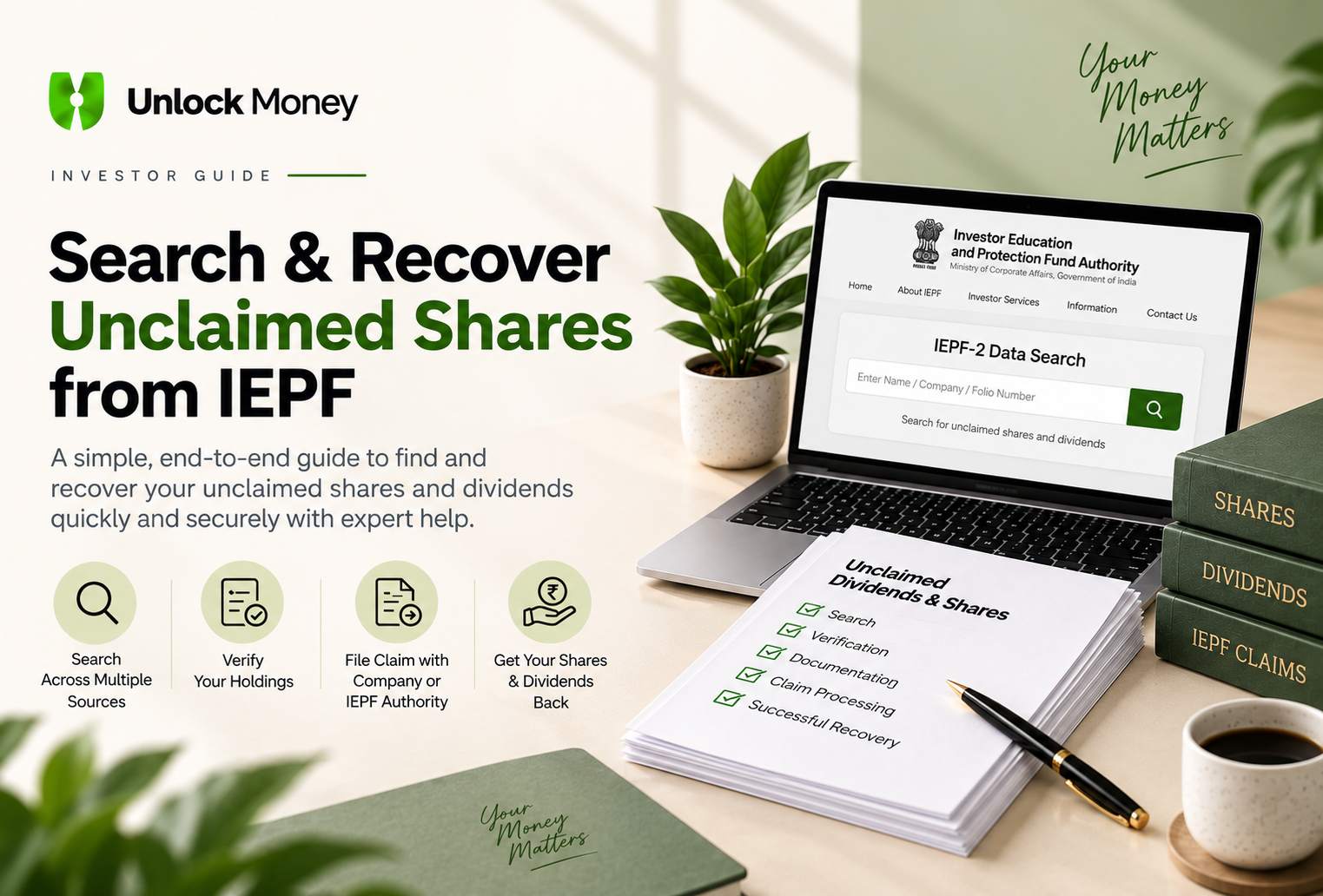
The Investor Education and Protection Fund portal at iepf.gov.in is the most comprehensive single source for forgotten shares in India. Under the Companies Act, 2013, companies are required to transfer shares and unclaimed dividends to IEPF when dividends go uncollected for seven consecutive years. The portal’s IEPF-2 Data Search tool contains records uploaded by hundreds of listed Indian companies.
If you find shares here, it means the dividends associated with those shares went unclaimed long enough to trigger a transfer. The shares are still yours, but recovering them requires a formal claim process through the Ministry of Corporate Affairs portal.
The Company’s Registrar and Transfer Agent
If dividends have been going unclaimed but fewer than seven years have passed since the first unpaid dividend, the shares may still be in the company’s register with dividends sitting in the Unpaid Dividend Account. These will not appear on the IEPF portal. To find them, you need to contact the company’s Registrar and Transfer Agent directly.
Every listed company in India has an RTA registered with SEBI. You can find the RTA for any company through the company’s investor relations page, the BSE listed company directory, or the NSE listed company directory. Providing your PAN or folio number to the RTA gives you a complete picture of your holding status and any pending dividend amounts.
Your Demat Account Statement
If you hold shares in demat form and have simply not checked your account in a while, your Depository Participant can provide a full holdings statement. Logging into your brokerage platform or requesting a consolidated statement from your DP shows all holdings currently in you demat account, including any that were credited through corporate actions like bonus shares you may not have noticed.
The NSDL IDeAS portal at eservices.nsdl.com and the CDSL easi portal at easi.cdsl.com also allow you to check your demat holdings by logging in with your PAN.
These portals can also confirm whether you have multiple demat accounts linked to
your PAN that you may have forgotten about.
Physical Share Certificates at Home
For investments made before the demat era, the evidence of ownership is a physical share certificate. These were issued by companies from the late 1970s through the mid 1990s and represent shares that were never converted to electronic form. Physical certificates are commonly found tucked into old files, stored in steel almirahs, or discovered among a deceased family member’s documents.
The presence of a physical certificate does not confirm the current status of the shares. The underlying shares may still be in the company’s register, may have moved to IEPF, or may have been converted to shares in a successor company following a merger. The certificate is the starting point for a search, not the answer itself.
BSE and NSE Company Disclosures
Listed companies are required to disclose their list of investors with unclaimed dividends in their annual reports, which are publicly available on the BSE and NSE websites. The investor relations sections of company websites also frequently carry unpaid dividend lists. Searching the annual report for a company whose shares you believe you held can confirm whether your name or folio appears in the unclaimed dividend disclosure.
Annual Information Statement on the Income Tax Portal
The Annual Information Statement available through the income tax e-filing portal at incometax.gov.in aggregates financial data from multiple sources linked to your PAN. This includes dividend income, demat account transactions, and in some cases demat account openings and closures. Reviewing your AIS can sometimes surface a demat account or dividend credit that you had forgotten about, particularly if you have held multiple accounts over the years.
Here is how to approach each of the sources above in a structured way.
Searching the IEPF Portal
1. Go to iepf.gov.in and navigate to the IEPF-2 Data Search tool under Investor Services.
2. Enter the investor’s name as registered with the company. If the name has variations, try multiple combinations: full name, surname only, initials plus surname.
3. Add the company name if you want to narrow results to a specific holding.
4. Enter the folio number directly if you have it from an old share certificate or dividend warrant for the most precise results.
5. Note every record that appears: the company name, folio number, number of shares transferred, and unclaimed dividend amount.
6. If a search returns no results, this does not confirm there are no forgotten shares.
It means either the shares have not yet been transferred to IEPF or the company has not yet uploaded the relevant data.
Contacting the RTA
For each company whose shares you believe you held, find the current RTA through the company’s investor relations page or the BSE or NSE directory. Contact the RTA with the investor’s name and PAN card number. Ask specifically whether any active folios exist under that PAN, what the current dividend status is for those folios, and whether any amounts are currently in the Unpaid Dividend Account or have been transferred to
IEPF.
Checking Your Demat Account
Log into your brokerage platform or contact your Depository Participant and request a complete holdings statement. Cross-check this against any companies you remember holding shares in. Check both NSDL and CDSL portals if you are unsure which depository your account is registered with, since some investors have accounts with both.
Reviewing Physical Certificates
For each physical certificate found, note the company name, folio number, certificate number, and number of shares. Then run a search on the IEPF portal using the folio number and company name to determine the current status. If no IEPF result appears, contact the company’s current RTA to check whether the folio is still active.
Finding a forgotten share or investment is only the first step. What you do next depends on where the shares currently sit and the circumstances of your specific case.
Shares Found on the IEPF Portal
If the IEPF portal confirms your shares are there, you need to file Form IEPF-5 through the MCA portal at mca.gov.in and send a physical document package to the company’s Nodal Officer. The claim is then reviewed by the Nodal Officer and the IEPF Authority before the shares are credited to your demat account and the dividends to your bank. This process typically takes three to six months for a standard case.
Shares Found with the Company’s RTA
If the RTA confirms that dividends are sitting in the Unpaid Dividend Account and the seven-year threshold has not been crossed, the recovery is simpler. You update your KYC and bank details with the RTA and request a revalidated dividend payment. This typically takes three to six weeks and does not require an IEPF filing.
Shares Found as Physical Certificates
If the certificate is valid and the shares are still in the company’s register, you dematerialise the certificate through your Depository Participant using a Dematerialisation Request Form. If the shares have already moved to IEPF, you file an IEPF claim. If the certificate is lost or damaged, you obtain a duplicate certificate first. If the original shareholder is deceased, you complete the transmission process alongside
the dematerialisation or IEPF claim.
Shares Found in a Forgotten Demat Account
If you discover a demat account you had forgotten about, you can either transfer the holdings to your primary account through an off-market transfer using a Delivery Instruction Slip, or you can start using the rediscovered account again if it is still active and compliant. Any account that is frozen for pending nomination or KYC compliance should be updated with your Depository Participant before attempting any transactions.
The search process itself is free and accessible. The government portals, company websites, and RTA contact channels are all publicly available. What most investors find, however, is that discovering a forgotten investment creates a new set of questions and challenges that are not straightforward to navigate.
Multiple Sources Give Incomplete Pictures
No single portal or database gives a complete view of an investor’s historical holdings. The IEPF portal only shows shares that have already been transferred. The RTA only knows about the holdings under a specific company’s register. The demat statement only reflects electronic holdings. Physical certificates cover only pre-demat investments.
A truly comprehensive search requires all of these sources to be checked in combination, which is time-consuming and requires knowing how to interpret inconsistencies across them.
Old Records Are Often Inconsistent
Company records from the 1980s and 1990s were maintained manually and frequently contain name variations, spelling errors, incorrect addresses, and mismatched PAN details. When a modern identity document does not match an old record, the recovery process stalls until the discrepancy is resolved. Identifying the discrepancy, understanding what documentation is needed to resolve it, and preparing that
documentation correctly requires familiarity with RTA processes that most investors do not have.
Corporate History Adds Complexity
A share certificate from the 1990s may refer to a company that has since merged with three other entities, been renamed twice, had a demerger, and changed its RTA. The current position of those shares, including whether a corporate action automatically converted them to shares in the successor entity or whether a separate claim is required, is not something a portal search will tell you. Tracing corporate history requires access to BSE and NSE filings and knowledge of how to interpret restructuring announcements.
Deceased Investor Cases Require Legal Navigation
When forgotten investments belong to someone who has passed away, the legal heir cannot simply submit a dematerialisation request or an IEPF claim in their own name without first establishing their right to the shares through the correct legal documentation. Which documents are required, from which authority, and in what format depends on the specific circumstances of the estate. Getting this wrong wastes months. Getting it right requires specific legal knowledge of transmission rules and state-level variations.
Unlock Money is a professional financial asset recovery service operated by AAPT Corp Advisors LLP. Our service begins with a comprehensive search that goes considerably further than what most investors can do on their own, and ends only when every recovered share and dividend has been credited and confirmed.
Comprehensive Cross-Source Search
We search the IEPF portal using multiple name variations and combinations. We contact relevant RTAs directly and request holding status information under the investor’s PAN. We review BSE and NSE company disclosures for investor names and folio numbers. We check demat account linkages under the investor’s PAN through NSDL and CDSL records where applicable. We assess every physical certificate
brought to us for current status before any recovery process begins.
The result is a search that surfaces forgotten investments from sources that individual investors frequently miss. We find shares in companies the client did not know to look for, dividends still with RTAs that have not yet crossed the IEPF threshold, and certificates whose shares have moved to IEPF while the client assumed they were simply inactive.
Accurate Valuation Before Recovery Begins
Once we identify forgotten shares, we provide an indicative current market value for each holding based on the current share price, adjusted for any bonus issues and stock splits since the original purchase. For many clients, this valuation is the first time they realise how significant their forgotten investments are. It also helps prioritise recovery efforts when multiple companies and processes are involved.
Correct Recovery Pathway for Every Holding
We assess each identified holding individually and determine the correct recovery
pathway: standard dematerialisation, IEPF claim, duplicate certificate application, KYC update with the RTA, or transmission for a deceased investor’s estate. For clients with holdings across multiple companies in different recovery states, we manage all pathways simultaneously so that every holding moves forward in parallel.
End-to-End Process Management
We prepare every document to the correct standard, file every form with verified data, manage every submission, respond to every Nodal Officer query, and track every claim through to its conclusion. You deal with a single team and receive regular consolidated updates across all your holdings. You do not need to contact a government portal, an RTA, or a company compliance officer yourself at any stage of the process.
Deceased Investor Estate Recovery
For families who have found forgotten investments belonging to a deceased parent or grandparent, we manage the complete legal and procedural process: establishing the legal heir’s right to the shares, preparing transmission documentation, coordinating dematerialisation or IEPF claims, and confirming final credits. We advise specifically on which legal documents apply to each case rather than applying a generic approach.
How do I search for forgotten shares in India without any documents?
A PAN card and the investor’s name are usually sufficient to begin a search. The IEPF
portal can be searched by name alone. RTAs can be contacted with a name and PAN to check for active folios. Unlock Money runs searches using these minimum details as the starting point and cross-references multiple databases to build a complete picture.
Can I find shares from companies that no longer exist?
Yes, in many cases. If the company merged with a successor entity, the shares may have been converted to shares in the new company. The RTA records and BSE or NSE corporate action filings document these conversions. Unlock Money traces the corporate history of any company mentioned on an old certificate or in a search result to confirm whether and where the shares currently sit.
How do I find out if a deceased parent had shares?
Search the IEPF portal under their name with multiple variations. Contact the RTAs for any companies you know or suspect they held shares in. Review any physical documents for certificates, dividend warrants, or broker confirmation letters. Check the annual information statement on the income tax portal under their PAN if it is accessible. Unlock Money conducts this research systematically and identifies holdings
across all sources.
Can I find shares if I do not know which companies were invested in?
Yes. An IEPF portal search by name alone returns results across all companies that
have uploaded data for that investor. For physical certificates, the company name is printed on the certificate. For demat holdings, NSDL and CDSL portals list all holdings under a linked PAN. Unlock Money combines all of these sources to produce a complete search without requiring the investor to know in advance which companies to check.
Is there a fee for checking whether I have forgotten shares?
The IEPF portal and company websites are free to search. Unlock Money’s initial search and assessment is done before any commitment is made. You receive a clear summary of what was found before deciding whether to engage the full recovery service.
How long does the full process take once forgotten shares are found?
For shares still with the company, a KYC update and revalidation typically takes three to six weeks. For IEPF claims, three to six months for standard cases. For cases involving deceased investors, physical certificates, or multiple companies, six to twelve months. Unlock Money provides a case-specific estimate based on the actual holdings identified in the search.
Forgotten shares and unclaimed investments in India represent a category of wealth that is entirely recoverable but rarely pursued because most investors and families simply do not know where to look or what to do once they find something.
The search itself is accessible through government portals, company records, and depository systems. The recovery process that follows depends on where the shares are found and the specific circumstances of the investor. Both the search and the recovery are processes that benefit significantly from professional support, particularly when the investments involve decades-old records, corporate restructurings, or deceased investor estates.
Unlock Money provides the complete solution: a thorough cross-source search that finds forgotten investments others miss, an honest assessment of what is recoverable and what it involves, and end-to-end management of every recovery process from the first search to the final demat credit.
Contact Unlock Money at unlockmoney.in today for a free initial search. Tell us what you know about the investor, and let our team find out what forgotten investments may be waiting to be recovered.
Do not hesitate to contact us. We’re a team of experts ready to talk to you.