


–
July 23, 2026
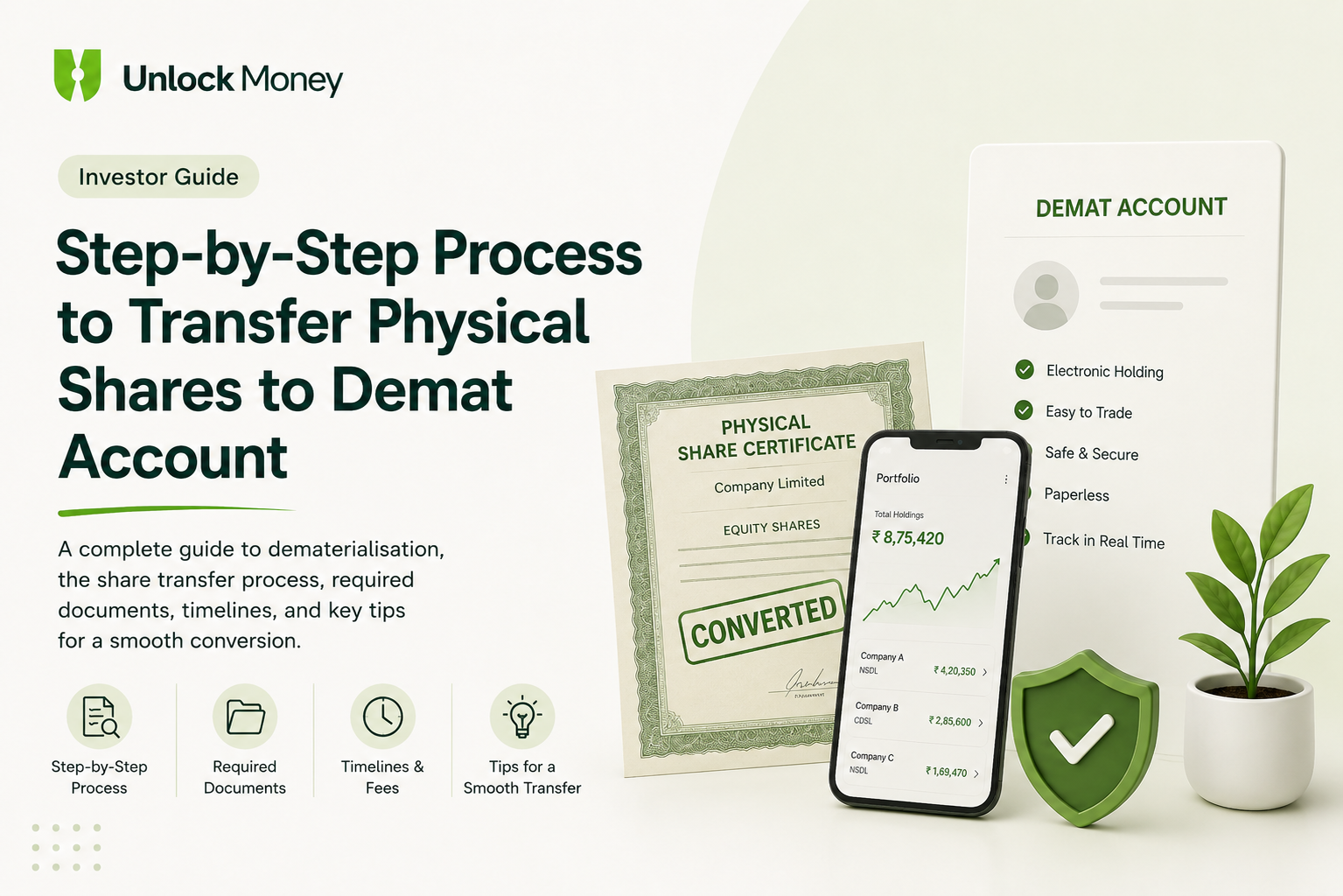
Millions of Indian investors are sitting on physical share certificates they have never converted to demat form. Some of these certificates have been tucked away in files and almirahs for decades, largely forgotten. Others were recently discovered while sorting through a family member’s belongings after they passed away. And some belong to people who simply never got around to converting them when the shift from physical to electronic shareholding happened in the late 1990s.
If you are in any of these situations, understanding the process to transfer physical shares to a demat account is one of the most important financial steps you can take. The process is called dematerialisation, and it is the only way to make your physical share certificates fully usable in today’s market.
This guide walks you through the complete share transfer process from physical to demat, step by step, in plain language. It covers who needs to do this, what documents are required, what the process involves at each stage, common problems that slow things down, and how Unlock Money helps when the process becomes complicated. Whether your certificates are in good condition or damaged, whether the original shareholder is still alive or has passed away, and whether the shares are still with the company or have already moved to IEPF, this guide covers your situation.
Dematerialisation is the process of converting physical share certificates into an electronic form held in a demat account. When shares are dematerialised, the original paper certificates are cancelled and the equivalent number of shares are credited to your electronic account with the depository.
In India, the two depositories that hold electronic securities are the National Securities Depository Limited (NSDL) and the Central Depository Services Limited (CDSL). You access either of these depositories through a Depository Participant (DP), which is a SEBI-registered entity such as a bank or stockbroker. Your demat account is held with the DP, and the DP interfaces with the depository on your behalf.
Once shares are in demat form, they can be traded on stock exchanges, transferred to another demat account, used as collateral, included in nominations, and tracked in real time through your broker’s platform. Physical certificates offer none of these benefits and come with real risks including loss, theft, and damage.
The demat conversion process is relevant to a wide range of investors. You likely need to act if any of the following applies to you.
• You hold physical share certificates in your own name that were purchased before India’s electronic depository system was established in the mid-1990s.
• You have inherited physical share certificates from a parent, grandparent, or other family member and have not yet completed the transmission and dematerialisation process.
You received physical certificates as a gift or through a family settlement that was never converted.
• You have certificates that were partially dematerialised years ago but some certificates from specific companies were left out.
• You have recently found old certificates and are not sure whether the underlying shares are still valid or have been transferred to IEPF.
• You received a communication from a company or its Registrar and Transfer Agent asking you to update your demat details or complete KYC, which is often triggered by unlinked physical folios.
If you are not sure whether your certificates are still active or whether the shares have already moved to IEPF, that check should happen before you begin the demat conversion process. Unlock Money can run that search for you as part of an initial assessment.
Before beginning the share transfer process, gather the following. Having everything ready before approaching your Depository Participant avoids unnecessary back and forth and reduces the risk of the application being returned & Process to Transfer Physical shares to demat Account.
An Active Demat Account
You must have an open and active demat account in your name with a SEBI-registered Depository Participant. If you do not yet have one, open it first. The account opening process requires your PAN card, Aadhaar card, a photograph, a cancelled cheque, and address proof. Processing typically takes two to five business days.
If the shares belong to a deceased person and you are a legal heir, the demat account for the transfer must be in your name, not the deceased’s. Transmission of the shares to your name must happen either before or alongside the dematerialisation process.
The Original Physical Share Certificates
You need the original certificates, not photocopies. Check that the certificates are in good condition and legible. If a certificate is damaged, torn, or faded, it may still be accepted, but you should inform the DP and RTA upfront so they can advise on the handling. If certificates are completely lost, a duplicate certificate process is required before dematerialisation can begin.
The ISIN for Each Company’s Shares
The International Securities Identification Number (ISIN) is a unique 12-character code that identifies each company’s specific class of shares. You will need the correct ISIN for every company whose shares you are converting. ISINs are available on the BSE website, NSE website, NSDL’s website, and CDSL’s website. Entering the wrong ISIN is one of the most common mistakes in the demat conversion process.
Your PAN Card and Identity Documents
Your PAN card must be linked to your demat account and must match the name on the share certificate. If there is a discrepancy between the name on the certificate and your current identity documents, this needs to be resolved before submission. Depending on the nature of the discrepancy, this may require an affidavit or supporting documents.
Here is the complete share transfer process laid out in order, from the first step to the
final credit in your demat account.
Step 1: Open a Demat Account if You Do Not Already Have One
Visit a SEBI-registered Depository Participant, which can be a bank, stockbroker, or financial institution registered with NSDL or CDSL. Submit your KYC documents, complete the account opening form, and wait for account activation. Most DPs now offer online account opening, which speeds up the process significantly.
Once your account is active, get your DP ID and Client ID from your DP. You will need these when filling the Dematerialisation Request Form. Also obtain a copy of your Client Master List (CML), which is an official document issued by the DP that confirms your demat account details. This document is required for several related processes including IEPF claims.
Step 2: Collect and Verify Your Physical Certificates
Take out all the physical share certificates you want to convert and check them carefully. Verify that your name on each certificate matches your current PAN and identity documents. Note the certificate numbers, folio numbers, and the number of shares mentioned on each one.
If you hold multiple certificates from the same company, they can all be submitted together under a single Dematerialisation Request Form. However, if you hold shares from multiple companies, you will need a separate form for each company.
Step 3: Obtain and Fill the Dematerialisation Request Form
The Dematerialisation Request Form (DRF) is provided by your DP. It is not a standardised national form and may differ slightly in format across DPs, though the required information is consistent. Fill it with the following details.
• Your full name as registered with the company
• Demat account DP ID and Client ID
• Name of the company whose shares you are submitting
• ISIN of the shares
• Folio number from the share certificate
• Number of shares being submitted for dematerialisation
• Certificate numbers of all certificates being submitted
Each detail must be accurate. The DP will cross-check the DRF against your demat account records and the certificates before forwarding to the RTA.
Step 4: Deface the Physical Share Certificates
Before submitting the certificates with the DRF, you must deface each certificate by writing the words Surrendered for Dematerialisation’ across the face of the certificate. Sign across the stamp or endorsement area as well if required by the DP.
This step is mandatory. It prevents the original certificate from being used again once the electronic credit has been issued. A certificate submitted without defacement may be returned by the DP or the RTA.
Step 5: Submit the DRF and Defaced Certificates to Your DP
Hand over the completed and signed DRF along with all defaced certificates to your DP The DP will verify the form and certificates, check that your demat account details match, and generate a Dematerialisation Request Number (DRN). The DRN is your reference for tracking the status of the request.
Keep a copy of the DRF and note the DRN. The DP then sends the request electronically to the depository and forwards the physical certificates to the company’s Registrar and Transfer Agent.
Step 6: RTA Verifies the Certificates
The Registrar and Transfer Agent for the company receives the physical certificates and the electronic dematerialisation request from the depository. The RTA verifies that the certificates are genuine, checks the folio records to confirm your ownership, and validates that the number of shares and certificate numbers match their records.
If everything is in order, the RTA confirms the request to the depository and cancels the physical certificates. If there are discrepancies, the RTA will raise a query with your DP, which will then contact you for clarification or additional documents.
Step 7: Shares Are Credited to Your Demat Account
Once the RTA confirms the request, the depository credits the shares to your demat account electronically. You will receive a notification from your DP when the credit is processed. The shares then appear in your demat account balance and are available for trading, transfer, or any other transaction.
The complete process from DRF submission to demat credit typically takes fifteen to thirty business days for a standard case with complete and accurate documentation.
Here is a consolidated list of what you need for a standard dematerialisation by a living original shareholder.
• Original physical share certificates, defaced as described.
• Completed and signed Dematerialisation Request Form.
• Copy of PAN card.
• Copy of Aadhaar card or other address proof.
• Copy of demat account statement or Client Master List confirming DP ID and Client ID.
For shares held in a deceased person’s name, additional documents are required.
• Death certificate of the original shareholder
• Legal heir certificate or succession certificate
• Nomination certificate if the deceased had registered a nominee
• Transmission Request Form submitted to the RTA to transfer the shares from the
deceased’s name to the heir’s name
• The heir’s own demat account details, PAN, and KYC documents.
Transmission and dematerialisation for a deceased investor’s shares can often be processed together, which saves time. However, the documentation must be complete and accurate across both processes simultaneously.
The demat conversion process is straightforward when everything is in order. In practice, several complications frequently arise, especially with older certificates. Knowing what they are helps you prepare and avoid delays.
Name Mismatch Between Certificate and Current Identity
This is the most common issue. If the name on the certificate reads differently from your PAN or Aadhaar, the RTA will raise a query before processing the request. Common variations include full name versus initials, maiden name versus married name, or spelling differences introduced during old data entry. Resolving this typically requires an affidavit explaining the variation, supported by identity documents. In some cases a gazette notification of name change is needed.
Incorrect or Missing ISIN
If the ISIN entered in the DRF does not match the company’s current active ISIN for that class of shares, the depository will reject the request. This can happen when a company has undergone a restructuring, demerger, or bonus issue that resulted in a new ISIN being assigned. Always verify the ISIN directly on the BSE or NSE website rather than relying on the certificate, which may be decades old.
Damaged or Illegible Certificates
Certificates that are torn, water-damaged, or faded may be partially or fully illegible. Some RTAs accept damaged certificates with a clear explanation letter, while others require a duplicate certificate first. The handling depends on the RTA’s internal policy and the severity of the damage. Submitting without checking the RTA’s requirements can result in the entire batch being returned.
Folio Number Not Found in RTA Records
If the folio number on the certificate does not match the RTA’s records, the verification will fail. This can happen when a company has changed its RTA over the years and records have not been fully migrated, or when the folio was created under a slightly different name format. Tracing the correct records requires direct communication with the current RTA, which can take several weeks if you do not know where to start.
Company Has Merged, Been Delisted, or Changed Its RTA
For certificates from companies that were active in the 1980s or 1990s, the company may have since merged with another entity, changed its name, or had its shares delisted. In these cases, the original RTA may no longer be the right contact, and the shares may have been converted to shares in a successor company. Tracing the current position of such shares requires research that most investors find difficult to do on their own.
Shares Already Transferred to IEPF
If dividends linked to the physical folio went unclaimed for seven years, both the dividends and the underlying shares may have already been transferred to the Investor Education and Protection Fund (IEPF). If this has happened, the physical certificate is no longer sufficient for dematerialisation through the standard DRF process. Instead, an IEPF claim using Form IEPF-5 is required to recover the shares, and they will be
credited to your demat account after the claim is approved.
This is one of the reasons Unlock Money recommends checking the IEPF status of any physical folio before beginning the demat conversion process. Filing a DRF for shares that are already in IEPF will result in rejection and wasted time.
When the original shareholder has passed away, converting physical shares to demat involves two processes running together: transmission and dematerialisation
Transmission is the legal transfer of shares from the deceased’s name to the legal heir’s name. It is governed by SEBI regulations and requires the legal heir to submit a transmission request to the company’s RTA with supporting documents. Once transmission is approved, the shares are reregistered in the heir’s name, and the standard dematerialisation process can proceed.
In practice, many RTAs allow both processes to be initiated simultaneously, which is more efficient. The legal heir submits the transmission request along with the DRF and all supporting documents in one package. The RTA processes the transmission first and then credits the shares directly to the heir’s demat account as part of the same workflow.
The documents required for transmission include the death certificate, a legal heir certificate or succession certificate depending on the value of the assets and whether a will exists, the original share certificates, the heir’s identity and address proof, and the heir’s demat account details. For holdings above a certain value threshold, RTAs typically require a formal succession certificate issued by a civil court.
Unlock Money has handled hundreds of deceased investor cases involving physical share certificates. We advise specifically on which documents are needed for your jurisdiction and asset value, so families are not spending time and money on documents they do not actually need.
Unlock Money is a specialised financial asset recovery service operated by AAPT Corp Advisors LLP. While our core work centres on IEPF share recovery and unclaimed dividend recovery, the physical share transfer process is a central part of many of the cases we handle. Here is how we add value at each stage.
Initial Assessment and IEPF Status Check
Before any DRF is submitted, we check whether the shares associated with your physical certificates are still in the company’s register or have already moved to IEPF. This single step prevents the most common wasted effort in the demat conversion process. If shares are in IEPF, we initiate the correct recovery process. If they are still with the company, we proceed with the standard dematerialisation approach.
RTA Identification and Record Tracing
We identify the current Registrar and Transfer Agent for each company, including in cases where the company has changed its RTA, merged with another entity, or been delisted. We trace the correct records and make initial contact with the RTA to understand any specific requirements before submitting your DRF.
Document Preparation and Name Mismatch Resolution
We prepare the complete document package for each company’s shares, verifying that every detail in the DRF matches your identity documents and the company’s records. Where name mismatches exist, we identify the appropriate resolution and prepare the supporting affidavit or documentation before submission, rather than discovering the problem after a rejection.
Duplicate Certificate Facilitation
For lost or significantly damaged certificates, we manage the complete duplicate certificate process, including the police report, indemnity bond, affidavit, newspaper advertisement, and RTA submission. We know the specific requirements of individual RTAs and format documents accordingly, which is why our duplicate certificate applications have a significantly lower rejection rate than self-filed ones.
Transmission and Demat for Deceased Investors
For inherited physical shares, we manage the complete transmission and dematerialisation process together. We assess whether a succession certificate is needed for your specific case, assist with obtaining it where required, and coordinate the RTA submission so that transmission and demat credit happen as part of a single efficient process.
IEPF Claim Filing Where Applicable
When physical certificates relate to shares that have already moved to IEPF, we file Form IEPF-5 on your behalf and manage the complete IEPF claim process through to the final demat credit. In many cases, clients come to us with a mix of certificates, some of which are eligible for direct demat conversion and some of which require an IEPF claim. We manage both simultaneously.
End-to-End Updates and Follow-Up
We track every submission with every RTA and follow up proactively when responses are overdue. You receive regular updates throughout the process without needing to call the RTA or your DP yourself. When queries arise, we respond to them immediately to avoid timeline resets.
How long does the physical to demat share transfer process take?
For a standard case with complete documentation and no complications, the process takes fifteen to thirty business days from DRF submission to demat credit. Cases involving name mismatches, damaged certificates, or deceased shareholders take longer, often two to four months. Where a duplicate certificate or succession certificate is also required, the total timeline can extend to four to six months.
Can I submit certificates from multiple companies in one request?
No. Each company requires a separate Dematerialisation Request Form because each DRF is forwarded to that company’s specific RTA for verification. You can submit multiple DRFs to your DP at the same time for different companies, and your DP will process them separately.
What happens to my physical certificates after I submit them?
The DP forwards the defaced certificates to the company’s RTA. Once the RTA verifies and confirms the dematerialisation request, the physical certificates are officially cancelled and destroyed by the RTA. You will not get them back. The electronic credit in your demat account is the new record of your ownership.
What if the company on my certificate has been delisted or merged?
If the company was merged into another entity, the shares may have been converted to shares in the successor company, often under a different ISIN. If the company was delisted due to winding up or regulatory action, the shares may be of limited value. Unlock Money traces the current status of any company mentioned on a physical certificate as part of its initial assessment.
Can I convert physical shares if the shareholder is deceased?
Yes, but you must complete the transmission process alongside dematerialisation. As a legal heir, you establish your right to the shares through the relevant legal documents, and the shares are transferred to your demat account after the RTA processes both the transmission and the demat request.
What if the shares have already been transferred to IEPF?
If the shares have moved to IEPF, the standard DRF process does not apply. You need to file an IEPF claim using Form IEPF-5 through the MCA portal. Upon approval, the IEPF Authority credits the shares directly to your demat account. Unlock Money checks IEPF status before initiating any demat conversion to prevent this mismatch.
Is there a fee for the dematerialisation process?
Yes. Your DP typically charges a nominal dematerialisation fee per certificate or per request. Rates vary by DP and are disclosed in your account terms. There may also be stamp duty charges applicable in some states. Unlock Money outlines all relevant costs as part of its case assessment before you commit to the service.
Transferring physical shares to a demat account is one of the most practical and valuable things you can do as an investor. It converts a piece of paper that you cannot trade or transfer into an electronic asset that is fully accessible, trackable, and legally compliant with SEBI’s current regulations.
The process is straightforward when documents are in order and shares are still in the company’s register. But a large proportion of physical share certificates in India today involve complications: outdated names, damaged certificates, deceased shareholders, merged companies, or shares that have already moved to IEPF. These situations require specific knowledge, the right contacts, and accurate documentation to resolve efficiently.
Unlock Money handles the complete physical to demat share transfer process, including all the complications that most investors find difficult to navigate on their own. Whether you have one certificate or twenty, whether the shares are with the company or in IEPF, and whether the investor is alive or has passed away, our team manages every step from the initial assessment to the final credit in your demat account.
Reach out to Unlock Money today for a free initial assessment and find out exactly what
is involved in converting your physical certificates to demat form.
Do not hesitate to contact us. We’re a team of experts ready to talk to you.