

–
August 29, 2026
At some point in the recovery of shares from IEPF, most investors reach the same conclusion: this is not something to handle entirely alone. The forms are precise, the documentation is unforgiving of small errors, and the review chain runs through multiple government and company authorities, each with its own standards. This is the point where people start searching for an IEPF consultant or an IEPF claims expert to take over.
But choosing the right professional help is its own decision, and not an easy one. The market for IEPF-related services in India includes everyone from dedicated recovery specialists to general financial advisors offering it as a side service to law firms that handle it as one small part of a broader practice. Not all of them bring the same depth of experience, and the difference shows up in how quickly and reliably your claim moves
through the system.
This guide is written to help you make that decision well. It covers what a genuinely
capable IEPF consultant actually does, the specific questions worth asking before you engage anyone, the red flags that signal a service is not equipped to handle your case, and why Unlock Money has built its practice specifically around getting the recovery of shares from IEPF right the first time.
Before evaluating who to work with, it helps to understand what the work itself involves. The recovery of shares from IEPF is governed by the Companies Act, 2013 and the IEPF Authority (Accounting, Audit, Transfer and Refund) Rules, 2016. It requires filing Form IEPF-5 through the Ministry of Corporate Affairs portal, preparing a precise physical document package for the company’s Nodal Officer, and navigating a review process that runs through the company’s Registrar and Transfer Agent and the IEPF Authority itself.
A genuine IEPF claims expert does considerably more than fill out a form. Their work spans several distinct areas of expertise.
Verifying Entitlement and Locating Records
Before any claim is filed, a competent consultant confirms exactly what is recoverable. This means searching the IEPF-2 database, checking the company’s current Registrar and Transfer Agent, and, where the company has merged, been renamed, or restructured, tracing the current status of the shares. Filing a claim based on outdated information from an old certificate, without this verification, is one of the most common reasons self-filed claims fail.
Preparing Documentation to Company-Specific Standards
Each company’s RTA has its own requirements for the indemnity bond format, the stamp paper denomination, and the supporting document set. An experienced consultant knows these variations because they have worked with the specific RTA before, not because they are applying a generic template and hoping it is accepted.
Managing the Legal Complexity of Deceased Investor Claims
A significant proportion of IEPF recovery work involves shares belonging to investors who have passed away. This requires understanding transmission rules, knowing when a legal heir certificate is sufficient versus when a succession certificate from a civil court is required, and coordinating that legal documentation consistently with the IEPF filing. This is specialised knowledge that general financial advisors often do not have deep
experience with.
Coordinating Across Multiple Authorities
A claim moves through the company’s Nodal Officer, the RTA, and the IEPF Authority, each with its own communication channel and response timeline. A capable consultant tracks every stage, responds to queries immediately, and escalates appropriately when a response is overdue, rather than leaving the claim to sit unmonitored.
If you are evaluating professional help for the recovery of shares from IEPF, these questions will tell you a great deal about whether a service provider is genuinely equipped for the work.
What Does Your Initial Assessment Include?
A capable IEPF claims expert should be able to run a search across the IEPF portal and relevant company records and give you a clear picture of what is recoverable before you commit to anything. If a service asks for a significant upfront payment before doing any assessment, or gives you a generic answer instead of case-specific findings, that is a signal to look elsewhere.
How Do You Handle Deceased Investor Cases?
Ask specifically how the consultant determines whether a legal heir certificate or a succession certificate is required for a deceased investor’s case. A vague answer, or an answer that defaults to the most expensive legal document regardless of the specific facts, suggests a lack of genuine experience with this scenario. A good consultant explains the distinction and applies it based on the actual value and jurisdiction involved
in your case.
What Happens If My Physical Certificates Are Lost or Damaged?
Recovery of shares from IEPF sometimes intersects with a duplicate share certificate process, particularly when physical certificates are involved. Ask whether the consultant handles this as part of their service or refers you elsewhere. A provider that manages both processes together, rather than leaving you to coordinate a separate duplicate certificate application on your own, saves significant time.
How Do You Track and Follow Up on Claims?
Ask what happens if the Nodal Officer does not respond within the expected window, or if the IEPF Authority raises a query. A consultant who has a clear, specific answer, such as an escalation process or a defined follow-up cadence, is more likely to keep your claim moving than one who simply files and waits.
What Are Your Fees and What Do They Cover?
A trustworthy IEPF consultant discloses fees clearly before you commit, including any incidental costs such as stamp paper, courier charges, or legal document assistance. Be cautious of services that are vague about total cost or that add unexpected charges partway through the process.
Can You Manage Multiple Companies Simultaneously?
If your case involves shares across several companies, ask how the consultant manages parallel claims. A provider without a structured system for tracking multiple simultaneous filings is likely to let some claims fall behind while focusing on others.
Just as there are signs of genuine expertise, there are also signs that a service provider is not equipped to handle the recovery of shares from IEPF reliably.
Guaranteed Outcomes or Unrealistic Timelines
No consultant can guarantee that the IEPF Authority will approve a specific claim, because the outcome depends on facts, documentation, and a government review process outside anyone’s direct control. A provider that promises guaranteed recovery or an unusually short timeline, such as a few weeks for a standard case, is either inexperienced or being misleading.
No Willingness to Explain the Process
A genuine expert can explain, in plain language, what stage your claim is at and why. If a provider gives vague reassurances instead of specific updates, that is a sign they may not actually be tracking your case closely, or do not understand the process well enough to explain it.
Pressure to Commit Before an Assessment
Reputable IEPF recovery services complete an initial search and assessment before asking for a full commitment. Pressure to sign an engagement or pay a large fee before any actual findings are shared should be treated with caution.
No Track Record with Complex Cases
If your case involves a deceased investor, physical certificates, or multiple companies, ask directly whether the provider has handled similar cases before. A provider whose experience is limited to simple, single-company, living-investor claims may not have the depth needed for a more complicated situation.
Unlock Money is operated by AAPT Corp Advisors LLP and has built its practice specifically around the recovery of shares from IEPF and related financial asset recovery work. Every element of our process is designed to answer the questions above with a clear, specific answer, not a general reassurance.
Our Initial Assessment Is Genuinely Thorough
We search the IEPF portal, relevant company RTA records, and BSE or NSE filings before telling you anything about what is recoverable. We check whether shares are still with the company or have already moved to IEPF, and we trace the current status of companies that have merged or restructured. You receive a specific, case-based assessment, not a generic answer, and this is done before you commit to engaging us.
We Have Deep Experience with Deceased Investor Cases
Our team assesses each deceased investor case individually, based on the specific value of the assets, the jurisdiction, and whether a nominee or will exists. We advise precisely on whether a legal heir certificate or succession certificate is required, and we assist with obtaining the correct document rather than defaulting to the most expensive or time-consuming option.
We Handle Physical Certificates and IEPF Claims Together
When physical share certificates are part of your case, we manage the dematerialisation process or the duplicate certificate application alongside the IEPF claim, rather than treating them as separate engagements. This coordinated approach prevents one process from stalling the other.
We Track Every Claim Actively
We confirm receipt of physical documents with each Nodal Officer, follow up proactively when verification is delayed, and respond to every query immediately. We track claims through the IEPF Authority’s review stages and notify you as soon as a sanction order is issued. No claim sits unmonitored.
Our Fees Are Disclosed Upfront
We explain our fees clearly during the initial assessment, including any incidental costs specific to your case. There are no hidden charges introduced partway through the process.
We Manage Multi-Company Portfolios as Standard Practice
When your case involves shares across several companies, we file and track each claim independently while providing you with a single, consolidated view of progress across your entire portfolio.
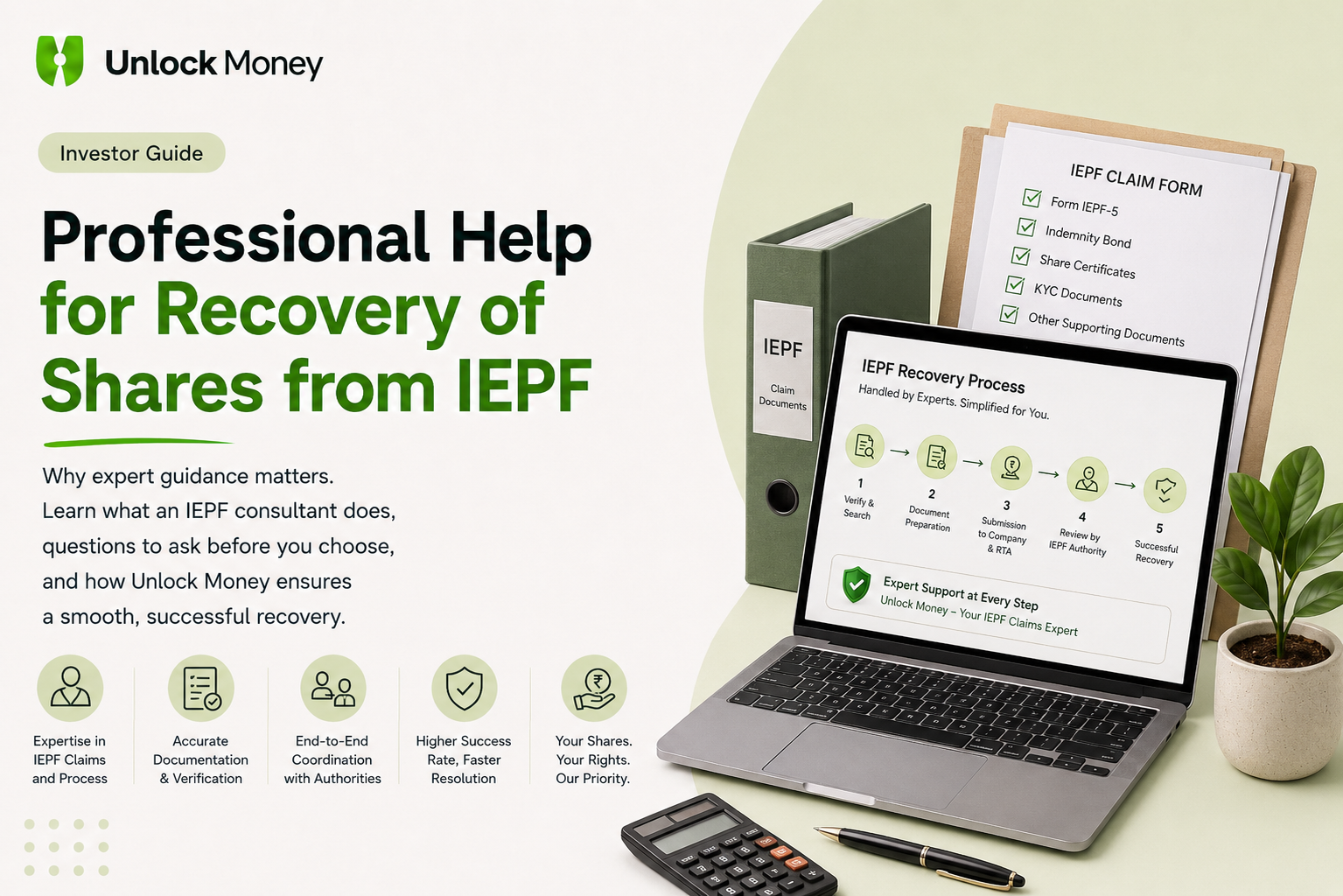
Here is the practical sequence of engaging Unlock Money for the recovery of shares from IEPF.
1. You share what you know about the investor and the shares with our team, through unlockmoney.in. This can be minimal information, such as a name and PAN, or detailed documentation including old share certificates.
2. We conduct a comprehensive search across the IEPF portal, RTA records, and company filings, and identify every holding that may be recoverable, whether already in IEPF or still with the company.
3. We provide a clear assessment of what we found, what is recoverable, what documentation your specific case requires, and what the realistic timeline looks like. This happens before you commit to anything.
4. Once you decide to proceed, we prepare every document to the correct standard for each company’s RTA and file Form IEPF-5 with verified data.
5. We manage all communication with Nodal Officers and the IEPF Authority, responding to every query and following up proactively at every stage.
6. We confirm the final demat credit and bank transfer once the sanction order is issued, and we close the case only when you confirm receipt.
Professional help is worth considering for a wide range of situations, not just complex ones.
• Investors who confirmed through the IEPF portal that their shares are in IEPF but are unsure how to file Form IEPF-5 correctly.
• Investors who attempted a self-filed claim and received a rejection or an unresolved Nodal Officer query.
• Legal heirs settling a deceased investor’s estate who need clarity on which legal documents apply to their case.
• Investors with shares across multiple companies who want a coordinated, single point of contact rather than managing several claims independently.
• NRI investors who cannot be physically present in India to manage document submission and follow-up.
• Anyone who values their time and would rather have an experienced team manage a multi-month process correctly than spend that time learning the process themselves
Is it worth paying for professional help if I could file the claim myself?
For a very simple case with no complications, self-filing is possible. But most cases involve at least one complicating factor: an old certificate with a name variation, a company that has changed its RTA, or documentation for a deceased investor. Professional help reduces the risk of rejection and the time lost to resubmission, which for most people is worth the cost.
How do I know if an IEPF consultant is genuinely qualified?
Ask specific questions about their initial assessment process, their experience with deceased investor cases, and how they track claims through the review process. A qualified consultant answers with specifics, not general reassurances. Unlock Money’s process is built to answer every one of these questions clearly.
What should I do if my current claim was rejected before I found professional help?
Share the details of the rejection with a qualified consultant. In most cases, the specific reason for rejection can be identified, corrected, and the claim refiled. Unlock Money regularly takes over cases that were previously rejected and manages the correction and resubmission process.
Does Unlock Money charge for the initial consultation?
No. The initial search and case assessment is completed before you commit to any engagement. You receive a clear picture of what is recoverable and what the process involves at no cost.
Can Unlock Money help even if my case involves a company that no longer exists in its original form?
Yes. We trace the corporate history of any company mentioned in a claim, including mergers, renamings, and restructurings, to determine the current status of the shares and the correct RTA to work with.
How long should I expect the recovery process to take with professional help?
Standard cases with complete documentation typically take three to six months from filing to final demat credit. More complex cases, including deceased investor claims or multiple companies, typically take six to twelve months. A qualified consultant gives you a case-specific estimate rather than a generic figure.
The recovery of shares from IEPF is a process that rewards precision and consistency. Choosing the right professional help is one of the most important decisions in that process, and it is worth evaluating carefully rather than engaging the first service that appears in a search result.
A genuine IEPF consultant should be able to give you specific, case-based answers before you commit to anything: what was found in an initial search, what documentation your case requires, and what the realistic timeline looks like. If a provider cannot answer these questions clearly, that tells you something important.
Unlock Money was built specifically around getting the recovery of shares from IEPF right, from the initial search through document preparation, filing, follow-up, and final credit. Whether your case is straightforward or involves a deceased investor, physical certificates, or shares across multiple companies, our team brings the specific experience needed to manage it correctly.
Contact Unlock Money at unlockmoney.in for a free initial assessment. Ask us the questions in this guide. Let our answers speak for the kind of professional help weprovide.
Do not hesitate to contact us. We’re a team of experts ready to talk to you.