


–
July 4, 2026
If you have been investing in stocks for a few years or if you are managing the financial affairs of a parent or grandparent there is a reasonable chance that some dividend payments have gone uncollected. In India, dividends that remain unclaimed for a defined period are transferred to a government fund, where they sit until the rightful owner comes to claim them.
The good news is that you can do an unclaimed dividend search online without much effort. The bad news is that most investors do not know this is even a possibility, and many never check until it is almost too late. By the time unclaimed dividends are transferred to the Investor Education and Protection Fund (IEPF), recovering them involves a more complex process than a simple bank transfer.
At Unlock Money, we specialise in helping individuals and families across India find and recover their unclaimed dividends and shares. Whether you want to do a quick dividend status check yourself or need expert help recovering funds that have already moved to IEPF, this guide covers everything you need to know.
Did You Know?
The IEPF Authority holds thousands of crores in unclaimed dividends transferred from
hundreds of Indian companies. Many of these belong to middle-class investors who
simply were not aware the money was owed to them.
A dividend is a portion of a company’s profits paid out to shareholders. When a company declares a dividend, it sets a record date anyone holding shares on that date is entitled to receive the payment. The company then dispatches dividend warrants (cheques) or initiates direct bank transfers to all eligible shareholders.
A dividend becomes unclaimed when it is not received, cashed, or credited to the shareholder’s bank account within thirty days of payment. This can happen for many reasons.
• The shareholder’s registered address is outdated, so the dividend cheque was returned undelivered.
• The bank account linked to the demat account is inactive, closed, or has mismatched details.
• The shareholder passed away before receiving the dividend, and no heir has stepped forward.
• The shareholder simply missed the communication and did not follow up.
• The PAN or KYC details on record are incorrect or incomplete, blocking electronic payment.
Under the Companies Act, 2013 and IEPF Rules, unclaimed dividends that remain unpaid for seven consecutive years must be transferred by the company to the IEPF. The underlying shares are also transferred at the same time. Once transferred, you can still recover both the dividend amount and the shares but the process becomes more involved.
Many investors only discover their dividends are unclaimed when they try to sell shares or receive a notice from the company’s Registrar and Transfer Agent (RTA). At that point, if seven years have not yet passed, the unclaimed amount may still be with the company and can be reclaimed with a relatively simple bank update or IEPF nomination process.
Once the amount crosses the seven-year mark and is transferred to IEPF, the recovery process involves formal paperwork, documentation, and waiting periods. Catching the issue early through a timely dividend status check saves both time and complexity.
Here are the most important reasons to check regularly:
• Early detection means simpler recovery directly from the company rather than through IEPF.
• A dividend status check can reveal KYC errors that are blocking all your future dividends, not just past ones.
• It helps you identify shares you may have forgotten about, some of which may have appreciated significantly.
• If you are managing a deceased family member’s estate, checking dividends gives you a clearer picture of the total financial assets to be settled.
.Companies are required to send notices before transferring dividends to IEPF, but these notices go to registered addresses which may be outdated.
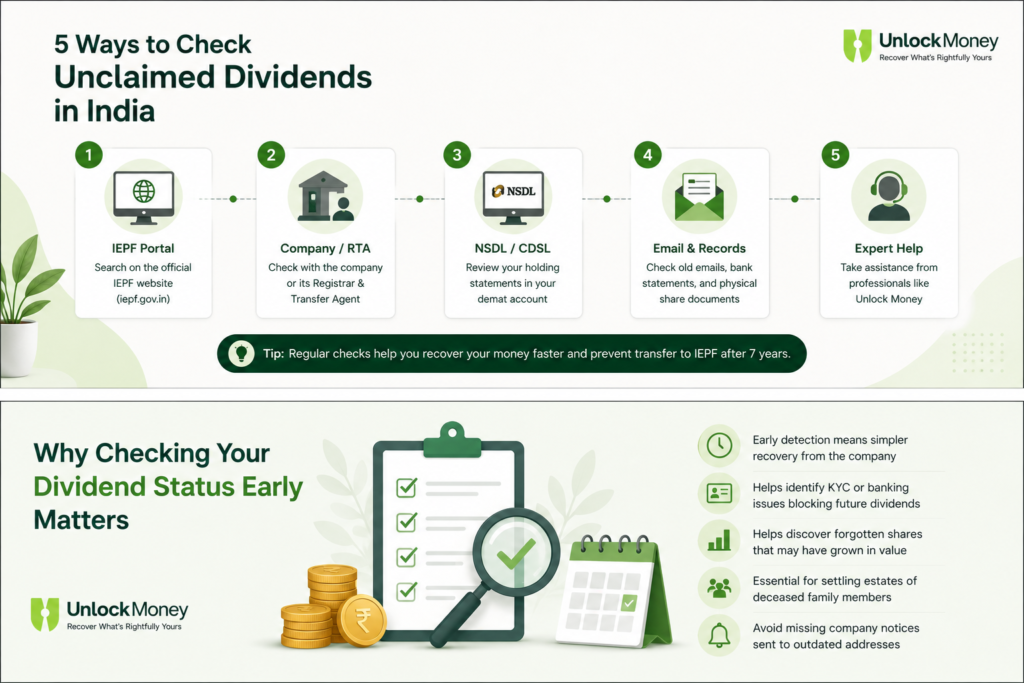
There are several methods available to do an unclaimed dividend search in India. Below are the main approaches, from the most direct to the most comprehensive.
Method 1: Check Through the IEPF Portal
The Ministry of Corporate Affairs maintains the official IEPF website at iepf.gov.in. Companies are legally required to upload data about unclaimed dividends and transferred shares to this portal.
1. Visit iepf.gov.in and navigate to the Investor Services or IEPF-2 Data Search section.
2. Enter the name of the original shareholder, the company name, or the folio number to begin the search.
3. Review the search results for any unclaimed dividend amounts or transferred shares linked to your details.
4. Note the company name, folio number, and the amount of unclaimed dividend for each record found.
5. If your dividends have already been transferred to IEPF, proceed to the claim process using IEPF Form 5 on the MCA portal.
Investors facing documentation issues can seek help through our share recovery services.
Search Tip
Company records from older investments may have spelling variations or abbreviated
names. If a name-based search returns no results, try searching by the company name
alone, or use partial names to cast a wider net.
Method 2: Check Directly with the Company or RTA
Every listed company in India has a Registrar and Transfer Agent a SEBI-registered entity that maintains shareholder records and manages dividend payments. You can find the RTA for any company by checking the investor relations section on the company’s website, or through BSE and NSE’s listed company directories.
Contact the RTA with your folio number or PAN card details and ask for a dividend payment history. The RTA can tell you whether any dividends are pending, whether they were returned undelivered, and whether any amounts are about to be or have already been transferred to IEPF. This is often the fastest and most accurate way to do a dividend status check for a specific company.
Method 3: Check via NSDL or CDSL Dividend Statements
If your shares are held in demat form, your depository either NSDL or CDSL maintains a record of your holdings and associated dividend transactions. Logging into your demat account through your broker or directly through NSDL’s IDeAS portal or CDSL’s easi platform will show you a ledger of dividend credits.
However, this only shows dividends that were successfully credited to your demat linked bank account. It will not show you dividends that were dispatched but went undelivered, or dividends linked to physical share certificates that were never dematerialised. For those, you need to check via the RTA or the IEPF portal directly.
Method 4: Contact Your Broker or Depository Participant
Your broker or DP can pull your complete transaction history, including dividend payments, from the depository records. While this is limited to dematerialised holdings, it is a convenient starting point for checking recent dividend activity. Ask specifically for a dividend payment report for the past seven to ten years to identify any gaps.
Method 5: Check Company Annual Reports and BSE or NSE Filings
Listed companies are required to disclose unclaimed dividend data in their annual reports. Most companies publish this on their website under the investor relations section. You can search for your name or folio number in the unpaid dividend list attached to the annual report, which companies typically update every financial year.
There are situations where you believe you should be receiving dividends but an unclaimed dividend search returns no results. Here are the most common explanations.
Shares Are in Physical Form and Never Transferred to Demat
If the shares were bought as physical certificates and were never dematerialised, the company still holds the record under your old folio number. Dividends linked to these physical holdings may have been dispatched as cheques to an old address and may have been returned. These will not appear in your demat-linked transaction history but should show up in an IEPF or RTA search.
KYC or Bank Details Are Outdated
If your registered bank account is inactive or the IFSC code on record is outdated, electronic dividend transfers will fail. The company logs these as undelivered and eventually reports them as unclaimed. Updating your KYC with the RTA is often enough to resume dividend payments and retrieve recently missed ones before they hit the seven-year limit.
PAN Not Linked to Folio
SEBI has mandated that all shareholders link their PAN to their folio number with the company’s RTA. If this has not been done, the company may not be able to process dividend payments electronically and may have flagged your folio as incomplete. In some cases, this results in dividends being withheld or marked as unclaimed.
Name or Address Mismatch
Even minor discrepancies a middle name included in one record but absent in another, or a variation in spelling can cause payment failures. Companies cross check your identity details before processing dividends, and a mismatch is enough to block payment.
Action Point
If you have not received dividends from a company you hold shares in, do not assume the company did not declare one. Check the company’s BSE or NSE filing for dividend
announcement dates and amounts, then compare against your own records. If there is a gap, initiate an unclaimed dividend search immediately.
Once you have identified unclaimed dividends through a search, the next step depends on where in the process the amount currently sits.
If the Dividend Is Still with the Company
If seven years have not passed since the dividend was declared and it has not yet been transferred to IEPF, the company or its RTA can process a fresh payment once you update your bank or contact details. You will need to submit a dividend revalidation request with the relevant RTA, along with updated KYC documents. This is the simplest and fastest resolution.
If the Dividend Has Been Transferred to IEPF
If the unclaimed amount has already moved to IEPF, you need to file a formal claim through IEPF Form 5 on the MCA portal. This form requires a range of documents including identity proof, address proof, demat account details, cancelled cheque, and in the case of deceased shareholders, legal documentation proving your right to the claim.
The claim is processed in stages: first by the Nodal Officer of the company, and then by the IEPF Authority. Timeline estimates vary from three months for straightforward cases to over a year for complex ones involving deceased shareholders, missing certificates, or legal disputes.
If the Shares Have Also Been Transferred to IEPF
When dividends go unclaimed for seven years, the underlying shares are also transferred to IEPF at the same time. A single IEPF Form 5 claim covers both theunclaimed dividends and the shares. Once approved, the dividend amount is credited to your bank account and the shares are transferred back to your demat account.
Knowing how to check unclaimed dividends is one thing. Actually recovering them especially when they have moved to IEPF is another matter entirely. At Unlock Money, we have built our service around exactly this challenge. Here is what we bring to the table.
Thorough Unclaimed Dividend Search
Our team conducts a comprehensive unclaimed dividend search that goes beyond what most individuals can do on their own. We check across the IEPF portal, RTA records, company annual reports, and depository data to build a complete picture of every dividend that may be owed to you or your family member. We do not stop at one database when several may be relevant.
KYC Update and Dividend Revalidation Support
If your unclaimed dividends are still with the company and have not yet reached the seven-year threshold, we help you get them back quickly. We identify the relevant RTA, prepare the KYC update request, and guide you through the revalidation process. In many cases, this is all that is needed to receive payment within a few weeks.
End-to-End IEPF Claim Management
For dividends and shares that have already moved to IEPF, we manage the complete claim process on your behalf. This includes filling IEPF Form 5, preparing all supporting documents, coordinating with the company’s Nodal Officer, and following up with the IEPF Authority until the claim is resolved. You do not need to track deadlines or decipher official correspondence we do that for you.
Deceased Shareholder Claims
We have significant experience handling claims where the original shareholder has passed away. These cases require additional documentation a death certificate, legal heir certificate, and often a succession certificate from a civil court. Our team guides families through this process efficiently, helping them avoid the delays and rejections that are common without professional support.
Physical Share Dematerialisation
If unclaimed dividends are linked to physical share certificates that were never dematerialised, we help with the dematerialisation process as well. This is often a prerequisite for claiming both the dividends and the shares from IEPF, and our team handles it in parallel to minimise overall recovery time.
Regular Status Updates
We keep you informed throughout the process. Every stage from initial search results to document submission, Nodal Officer verification, and IEPF Authority processing is communicated to you clearly and regularly. You will never be left wondering where your claim stands.
Unlock Money’s dividend recovery service is designed for a wide range of situations.
• Investors who have not received dividend payments from a company and want to understand why.
• Families managing the financial estate of a deceased parent or grandparent, where dividend history is unclear.
• NRIs who invested in Indian stocks before moving abroad and have not updated their banking or contact details.
• Shareholders who received a notice from a company or RTA warning that their dividends will be or have been transferred to IEPF.
• Anyone who has found old physical share certificates and wants to understand what dividends may be owed
• Investors whose bank accounts were closed or inactive for a period, potentially causing dividend transfer failures.
• People who held shares across multiple companies and want a single, consolidated unclaimed dividend search rather than checking each one individually.
If you are not sure whether you have unclaimed dividends, the answer is simple: let us check. An initial search costs you nothing but a few minutes of your time, and the results can be genuinely surprising.
Our Commitment
Unlock Money is straightforward about what we can and cannot achieve. Before you commit to our service, we give you an honest assessment of your case what is recoverable, what the process involves, and a realistic timeline. No false hope, no vague promises.
A woman in her fifties reached out to Unlock Money after finding a bundle of old share certificates among her late mother’s belongings. Her mother had bought shares in four companies in the 1990s but had moved twice since then and never updated her address with the RTAs. Dividend cheques had been bouncing back for years.
An unclaimed dividend search revealed that two of the companies had already transferred both the dividends and the shares to IEPF. The other two companies still held the dividends the seven-year period had not yet elapsed for those.
For the two companies still holding the funds, we initiated a KYC update and dividend revalidation request. For the two IEPF cases, we filed IEPF Form 5 with the full documentation package. Within five months, the client had recovered the dividends from all four companies a total that was significantly higher than she had expected, given how much the share prices had appreciated over the years.
This kind of outcome is not unusual. The key is knowing where to look and how to navigate the process correctly once you find something.
Is it free to search for unclaimed dividends?
Yes, the IEPF portal and company annual reports are publicly accessible at no cost. Unlock Money’s initial search and case assessment is also conducted before any commitment on your part. You will know exactly what is owed before deciding whether to proceed with the full recovery service.
How far back can I search for unclaimed dividends?
There is no time limit on claiming dividends from IEPF. Whether the dividend was declared five years ago or twenty-five years ago, you can file a claim. The government holds the funds indefinitely until a rightful claimant comes forward.
Can dividends be recovered if the shareholder has passed away?
Yes. Legal heirs are entitled to claim unclaimed dividends belonging to a deceased shareholder. The required documentation depends on the case some require only a death certificate and heir affidavit, while others may need a succession certificate from a civil court. Unlock Money handles both types.
What if my KYC details do not match the company records?
A KYC mismatch is one of the most common causes of dividend payment failures. Updating your KYC with the relevant RTA is the first step. We assist with this process and ensure all documents submitted are accurate and consistent to avoid rejection.
Can I claim dividends and shares in a single process?
Yes. If both the dividends and the shares have been transferred to IEPF, a single IEPF Form 5 claim covers both. Upon approval, the dividend amount is credited to your bank account and the shares are transferred to your demat account simultaneously.
How long does the full recovery process take?
If the dividend is still with the company, a KYC update and revalidation request can result in payment within three to six weeks. For IEPF claims, the timeline typically ranges from three to nine months for standard cases and longer for complex situations involving deceased shareholders or disputed records.
Unclaimed dividends are more common than most people realise, and the amounts involved can be substantial especially when compounded over years and combined with the value of underlying shares. A simple dividend status check is all it takes to find out whether money is owed to you, and acting early makes the recovery process far simpler.
Whether your dividends are still with the company or have already moved to IEPF, Unlock Money is here to help. Our team conducts thorough unclaimed dividend searches, handles all documentation, and manages the complete recovery process on your behalf from the first search to the final credit in your bank account.
Do not leave money behind that belongs to you or your family. Reach out to Unlock Money today and find out what your unclaimed dividends are worth.
Do not hesitate to contact us. We’re a team of experts ready to talk to you.