


–
सितम्बर 8, 2026
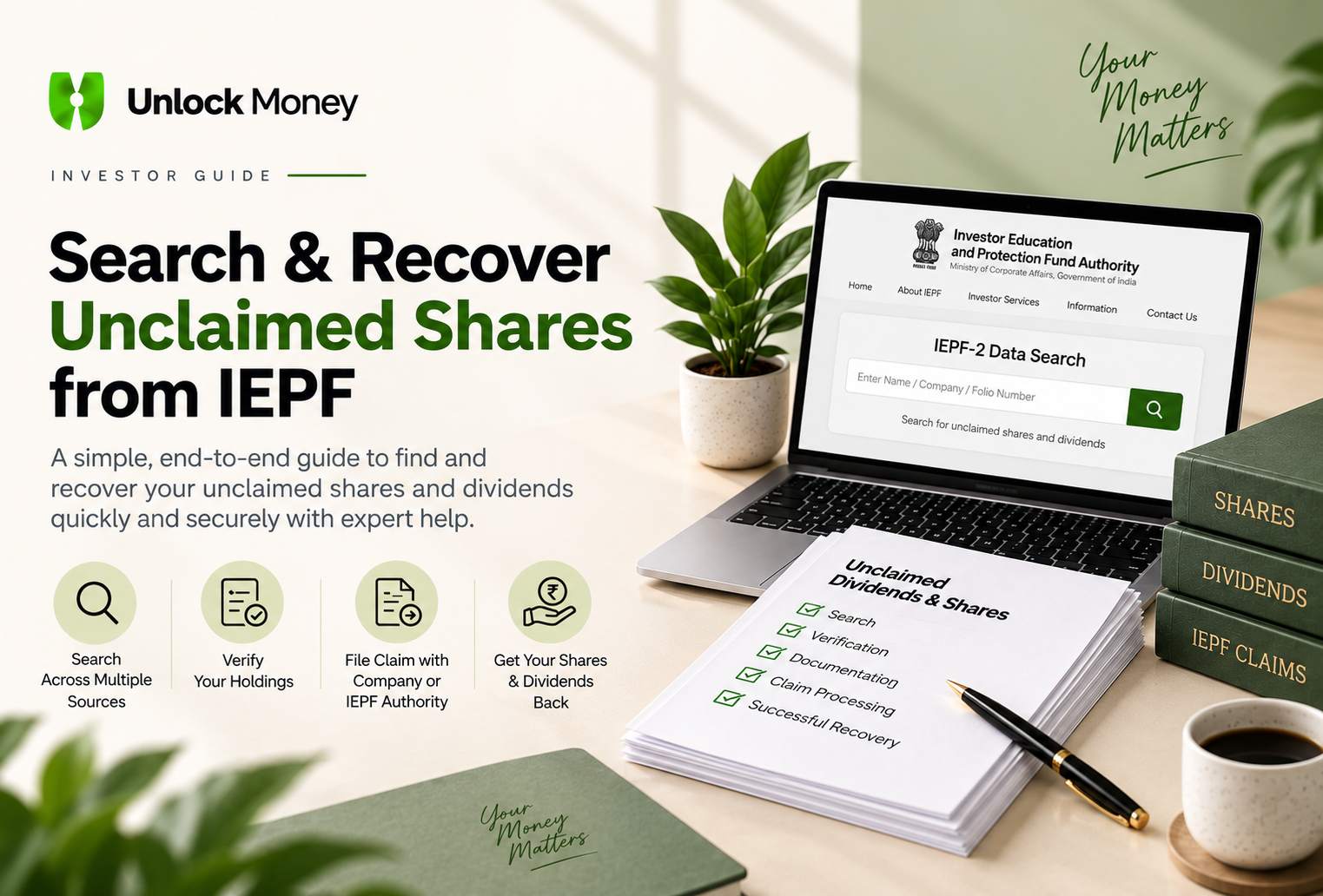
You want two things, and you want them in this order: find out whether you have shares in IEPF, and if you do, get them back. Not a general explanation of what IEPF is. Not a history lesson on dematerialisation. Just the search, the answer, and the recovery.
This page gives you exactly that. Unlock Money runs a complete IEPF asset search across every relevant source, tells you precisely what we find, and manages the full recovery of any shares and dividends that are owed to you. This is not a self-service tool that hands you a list of results and leaves you to figure out the rest. It is an end-to end search and recovery service, built specifically for people who are ready to act.
Below is how the search works, what the results actually mean, and how the recovery process runs from confirmation to the final credit in your demat account.
A proper IEPF asset search is not a single lookup. It is a combination of checks across different sources, because no single database gives a complete picture on its own.
The IEPF-2 Database
This is the core government database, searchable at iepf.gov.in, showing shares and dividends that companies have already transferred to the Investor Education and Protection Fund. A search here by name, folio number, or company confirms whether specific holdings have crossed the seven-year unclaimed threshold and moved into government custody.
Company RTA Records
The IEPF-2 database only shows shares that have already been transferred. It does not show shares still sitting in a company’s own register with dividends unpaid but not yet transferred. A complete search checks directly with the relevant company’s Registrar and Transfer Agent to catch holdings that have not yet crossed the seven-year mark but are still effectively unclaimed and at risk of transfer.
Corporate History and Restructuring Records
Old shares are sometimes searched for under a company name that no longer exists in that form. The company may have merged, been renamed, or been restructured, and the current holding may sit under a completely different name or ISIN. A thorough recover old shares search traces this corporate history through BSE and NSE filings to find the current position of the shares.
Depository Records Under Your PAN
NSDL and CDSL hold demat account data linked to your PAN. Checking these can reveal forgotten demat accounts, confirm which depository holds a specific investment, and cross-verify that recovered shares have a valid destination account waiting for them.
If you want to run an initial check before engaging any service, here is exactly how to do it.
1. Go to iepf.gov.in and find the IEPF-2 Data Search tool, usually listed under Investor Services.
2. Search using the investor’s full name first. If no results appear, try variations:
surname only, initials with surname, or a shortened first name, since old records are often entered inconsistently.
3. If you know the company name, search with it directly to narrow results and reduce false negatives from name variation.
4. If you have a folio number from an old certificate or dividend warrant, use it for the most accurate results.
5. Record every match: company name, folio number, number of shares, and unclaimed dividend amount.
6. If nothing appears, do not conclude there is nothing to recover. Contact the relevant company’s RTA directly with your PAN to check for dividends that have not yet crossed the IEPF transfer threshold.
This gets you a partial picture. A genuinely complete search, one that also checks corporate restructuring history and cross-references your demat accounts, is where Unlock Money’s search goes further than what most people can do with a portal alone.
Finding shares in IEPF is the discovery. Getting them back is the recovery. Here is exactly what that process involves once Unlock Money confirms a holding.
Step 1: Confirm Claimant Eligibility
We confirm which category applies: original shareholder, joint holder, registered nominee, or legal heir. This determines the exact documentation required for your specific case, rather than applying a generic checklist.
Step 2: Prepare Your Demat Account
IEPF releases recovered shares only into an active, KYC-compliant demat account with a linked bank account and completed nomination registration. We verify this is ready before filing anything, so a compliance issue does not surface after approval and delay your credit.
Step 3: File Form IEPF-5
We file the official claim form through the MCA portal with verified inputs: the company’s current Corporate Identification Number, the correct ISIN, the folio number, your demat account details, and every eligible dividend year. Every field is checked against current records before submission.
Step 4: Submit the Physical Document Package
We prepare the indemnity bond, advance receipt, Client Master List, cancelled cheque, and identity documents to the exact format each company’s RTA requires, and send the complete package to the Nodal Officer.
Step 5: Track Verification Through to Approval
We follow up with the Nodal Officer, respond to any query immediately, and track the claim through the IEPF Authority’s review until a refund sanction order is issued.
Step 6: Confirm the Final Credit
Once approved, the shares are credited to your demat account and the dividend amount to your bank account. We confirm receipt with you and close the case only once everything has actually arrived.
Shares that have sat unclaimed for many years, sometimes decades, often need extra care during recovery. Here is what commonly comes up and how it is handled.
The Certificate Predates the Demat System
If the shares were originally issued as physical certificates, dematerialisation or an IEPF claim requires either the original certificate or, if it is lost or damaged, a duplicate certificate obtained from the RTA first. We manage this alongside the IEPF claim so one process does not sit waiting on the other.
The Original Investor Has Passed Away
Recovering old shares on behalf of a deceased investor requires establishing your right as legal heir through the correct documentation, whether that is a nomination certificate, a legal heir certificate, or a succession certificate from a civil court, depending on the specifics of the estate. We assess this precisely for your case rather than defaulting to the most burdensome option.
The Company No Longer Exists in Its Original Form
Companies from the 1980s and 1990s frequently merged, were renamed, or went through demergers. The shares from an old certificate may now correspond to a holding in a completely different company. We trace this corporate history as part of every search so the recovery targets the correct current entity.
Name Records Do Not Match Current Identity Documents
Decades-old manual records commonly show name variations that do not match a current PAN or Aadhaar. We identify this early and prepare the correct supporting documentation, such as an affidavit, before it becomes a rejection reason.
A search that only tells you shares exist, without a clear path to recovering them, leaves you exactly where you started, just with more certainty about the problem. This is why Unlock Money treats search and recovery as one continuous service rather than two separate transactions.
When we search, we are already thinking about what the recovery will require: is the demat account ready, does the name match, is a legal document going to be needed, has the company restructured. This means the search itself produces a recovery plan, not just a list of findings.
This search and recovery service is built for anyone ready to move from wondering to knowing, and from knowing to recovering.
Investors who suspect they have shares in IEPF but have not yet confirmed it
• Investors who ran a basic portal search themselves and found matching records
• Families who found old share certificates and want to know their current status
• Legal heirs who need to search on behalf of a deceased investor and recover what is owed
• Investors with shares across several companies who want one search covering all of them
• NRI investors who cannot easily run RTA checks or file documents from outside India • Anyone who tried a self-filed IEPF claim, hit a rejection, and wants it corrected and resubmitted properly iepf unclaimed shares search.
To start, you do not need a complete file of documents. You need enough to begin the search.
• The investor’s full name
• PAN card number if available
• Any company names you believe shares were held in
• A folio number, if you have one, from an old certificate or dividend warrant
• Whether the investor is alive, and if not, your relationship to them
If all you have is a name and a hunch, that is still a valid starting point. Contact Unlock
Money at unlockmoney.in and we take it from there iepf unclaimed shares search,
What if the search finds nothing?
A negative search result does not necessarily mean there is nothing to find. It may mean the company has not yet uploaded relevant data, the dividends have not yet crossed the IEPF threshold, or the search parameters need adjusting for name variations. We confirm this clearly rather than leaving you with an inconclusive answer iepf unclaimed shares search.
Can I search for shares under a company that no longer exists?
Yes. We trace the corporate history of any company mentioned in your records, including mergers, renamings, and restructurings, to determine where the current holding sits and under what name or ISIN.
How long does the recovery take once shares are found?
Standard cases take three to six months from filing to final credit. Cases involving deceased investors, physical certificates, or multiple companies typically take six to twelve months. We give you a specific estimate after the search, not a generic figure.
Is the search free?
Yes. The initial search and assessment is done before any commitment. You know exactly what was found and what recovery would involve before deciding whether to proceed.
Can I search and recover shares for more than one company at once?
Yes. We run a single search across all companies you provide information for, and manage simultaneous recovery filings for each one, with consolidated updates so you have one point of contact for the entire portfolio.
An IEPF unclaimed shares search only matters if it leads somewhere. Finding out your shares exist in a government database and then being left to figure out the recovery process on your own solves half the problem and leaves the harder half untouched.
Unlock Money runs the complete search across every relevant source and manages the full recovery of anything we find, from the first lookup to the final demat and bank credit. Whether you are searching for yourself, a family member, or a deceased investor’s estate, the process is the same: one search, one team, and a clear path from discovery to your money back in your hands.
Contact Unlock Money at unlockmoney.in today. Tell us what you know, and let us search, confirm, and recover what is yoursiepf unclaimed shares search.
हमसे संपर्क करने में संकोच न करें। हम विशेषज्ञों की एक टीम हैं जो आपसे बात करने के लिए तैयार हैं।