


–
सितम्बर 3, 2026
You have confirmed you have unclaimed dividends. Maybe you searched the IEPF portal and found your name against a company. Maybe an RTA told you there is an amount sitting in an Unpaid Dividend Account. Maybe you are simply certain, from an old share certificate or a family member’s records, that dividends are owed and have not been claimed.
What you want now is not another explanation of what unclaimed dividends are. You want to know how to actually claim them, without the process turning into a months-long cycle of paperwork, rejected forms, and unanswered phone calls to government offices. That is exactly what this guide gives you, and it is exactly what Unlock Money delivers as a dividend recovery service.
Claiming unclaimed dividends in India is not complicated in principle. It becomes complicated in practice because of small, avoidable errors: a name that does not quite match across documents, an indemnity bond in the wrong format, a demat account that turns out to be inactive right when you need it. Every one of these creates delay. None of them needs to happen if the claim is prepared correctly the first time.
Unlock Money is a dedicated dividend recovery service operated by AAPT Corp Advisors LLP. We manage the complete claim process for you, end to end, so the hassle stops being your problem. Here is exactly how the process works, and how we remove the friction at every step.
Before diving into the process, it matters which of two situations applies to you, because the path is different and one is considerably simpler than the other.
If Your Dividends Are Still with the Company
If fewer than seven years have passed since the dividend went unclaimed, the money is still sitting in the company’s Unpaid Dividend Account. This is the easier claim. You update your KYC and bank account details with the company’s Registrar and Transfer Agent and request a revalidated payment. No government portal filing is required. This typically takes three to six weeks.
If Your Dividends Have Been Transferred to IEPF
If seven consecutive years have passed, the company was legally required to transfer the unclaimed dividend, along with the associated shares, to the Investor Education and Protection Fund. Claiming this requires filing Form IEPF-5 through the government’s MCA portal, along with a physical document package sent to the company’s Nodal Officer. This route takes three to six months for a standard case.
Both paths lead to the same outcome, your money back in your bank account, but the second path has considerably more steps and more room for error. Unlock Money checks which situation applies to you as the very first step, so you are never pursuing the wrong process.
If your dividends have not yet reached the seven-year IEPF transfer threshold, here is the straightforward path to getting them back.
1. Identify the company’s current Registrar and Transfer Agent. You can find this through the company’s investor relations page or the BSE and NSE listed company directories.
2. Contact the RTA with your PAN or folio number and ask for confirmation of any unclaimed dividend amount currently held in the Unpaid Dividend Account.
3. Submit updated KYC documents, including your current address proof, PAN, and a cancelled cheque from an active bank account.
4. Request a dividend revalidation or re-dispatch. The RTA processes this and initiates a fresh payment to your updated bank account.
5. Confirm receipt of the payment. This typically arrives within three to six weeks of a complete request.
This process does not require a government portal filing, and it is the faster route whenever it applies. The catch is that many investors do not realise this option exists and instead assume all unclaimed dividends require an IEPF claim, which adds unnecessary time and paperwork to something that could have been resolved in weeks.
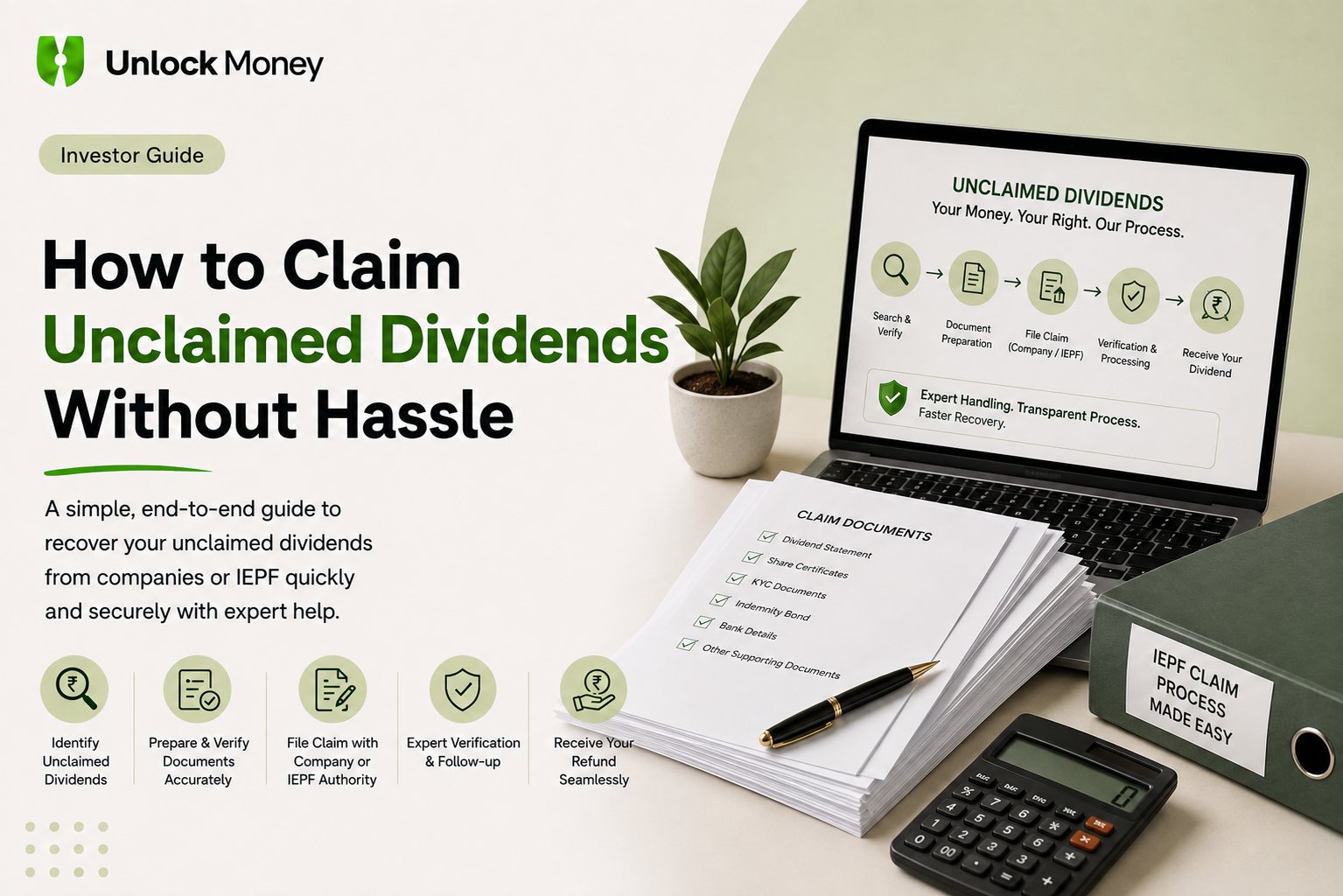
If your dividends have moved to IEPF, here is the complete process, step by step, without the hassle of guessing what comes next at each stage.
Step 1: Confirm the Details on the IEPF Portal
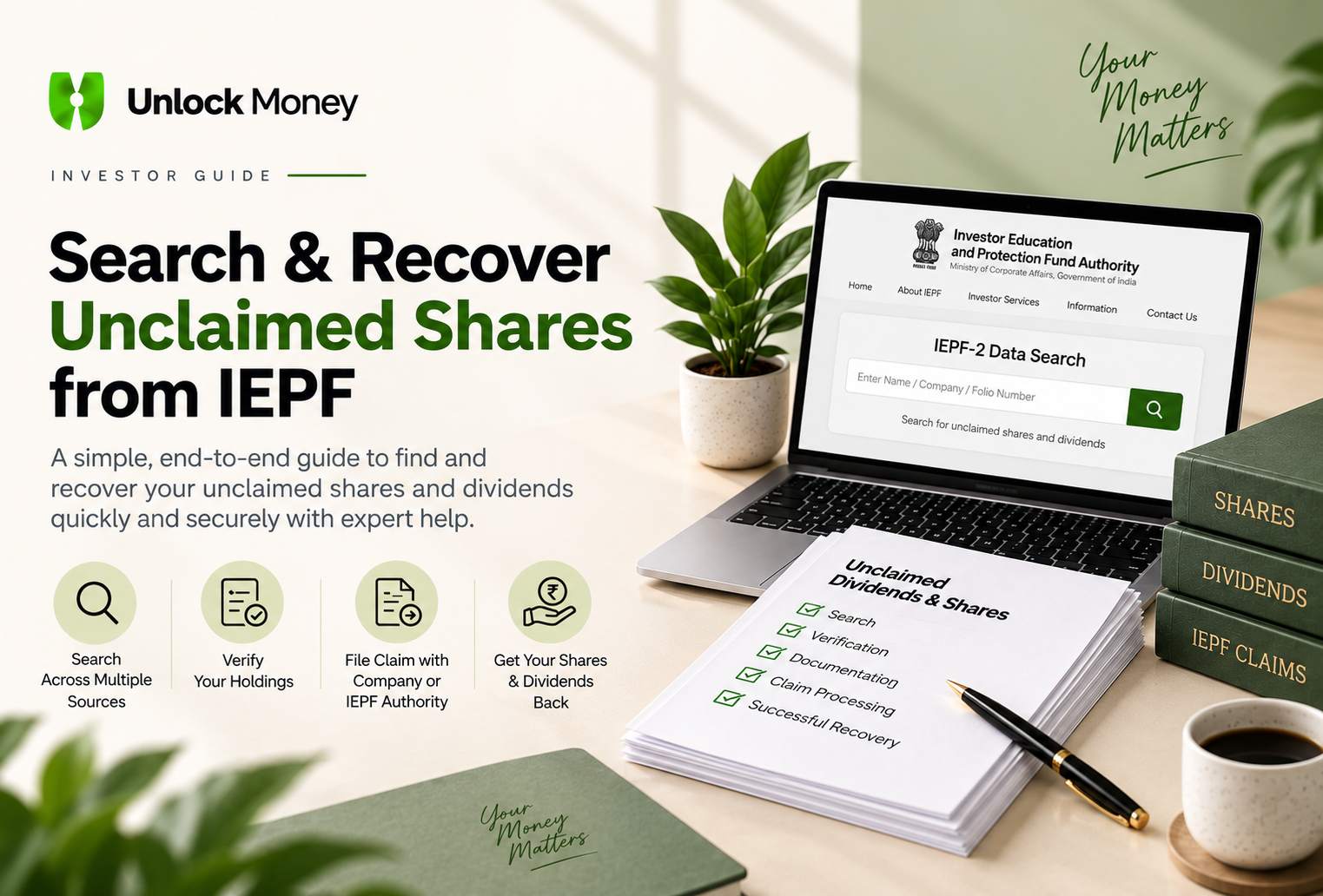
Visit iepf.gov.in and search the IEPF-2 Data Search tool by name, company, or folio number. Note the exact company name, folio number, number of shares, and unclaimed dividend amount shown.
Step 2: Get Your Demat Account Ready
IEPF releases funds and shares only to an active, KYC-compliant demat account with completed nomination registration and a linked bank account. Confirm this before filing anything, because discovering an issue here after your claim is approved adds unnecessary delay.
Step 3: File Form IEPF-5
This is the official claim form, filed online through the MCA portal at mca.gov.in. It requires the company’s current Corporate Identification Number, the correct ISIN, the folio number, your demat account details, and the specific dividend years being claimed. Save the acknowledgement and Service Request Number generated after submission.
Step 4: Prepare and Send Your Physical Documents
Compile the physical document package: the Form IEPF-5 acknowledgement, identity and address proof, a Client Master List from your Depository Participant, a cancelled cheque, an indemnity bond in the format specified by the company’s RTA, and an advance receipt. Send this to the company’s Nodal Officer.
Step 5: Wait for Verification and Approval
The Nodal Officer verifies your documents and forwards them to the IEPF Authority, which reviews the claim and issues a refund sanction order if satisfied. This stage typically takes two to four months.
Step 6: Receive Your Money and Shares
Once the sanction order is issued, your dividend amount is credited to your bank account and the associated shares are credited to your demat account, usually within one to two weeks.
The steps above look manageable when written out cleanly. The hassle in claiming unclaimed dividends does not come from the number of steps. It comes from small errors at each step that most people do not know to watch for until it is too late.
A Name That Does Not Quite Match
Old company records frequently show names differently from how they appear on a current PAN or Aadhaar card. Full name versus initials, a maiden name versus a married name, a spelling variation from decades-old manual data entry. Any of these triggers a query from the Nodal Officer, and resolving it requires an affidavit or
supporting documents, adding weeks.
An Indemnity Bond in the Wrong Format
Every company’s RTA has its own specific format requirements for the indemnity bond, the stamp paper denomination, and how it should be executed. There is no single standard template that works everywhere. A bond that does not match the specific RTA’s requirements gets returned, and you are back to square one on that portion of the process.
A Demat Account That Turns Out to Be Frozen
SEBI requires demat accounts to have completed nomination registration. An account that has not completed this can be frozen for debit transactions, which includes receiving a credit from an approved IEPF claim in some circumstances. Many investors only discover this after their claim has already been approved, which adds an entirely avoidable delay at the worst possible point.
A Query That Goes Unanswered
After you submit your physical documents, the Nodal Officer may raise a query if anything looks unclear or inconsistent. You typically have a limited window to respond. If you do not know a query has been raised, or do not know how to answer it correctly, your claim can be returned entirely, meaning you restart the review clock.
Missing Dividend Years
If a company declared dividends across several years and all of them went unclaimed, Form IEPF-5 requires you to specify every relevant year. Miss one, and you receive only partial credit, requiring a second filing to recover the rest. Most people do not have easy access to a company’s complete dividend history to check this.
Unlock Money exists specifically to take every one of the friction points above off your plate. Here is what our dividend recovery service actually does for you.
We Confirm the Correct Path First
Before anything is filed, we check whether your dividends are still with the company or have moved to IEPF. This determines the entire approach and prevents you from pursuing the longer IEPF process when a faster RTA request would work just as well.
We Verify Every Name and Detail Before Submission
We check the name, folio number, ISIN, and company details against current records before filing anything, catching mismatches and inconsistencies before they become a Nodal Officer query. If a name discrepancy exists, we prepare the correct supporting documentation upfront rather than waiting for a rejection to tell us it is needed.
We Prepare Documents to Each RTA’s Exact Standard
We know the specific format requirements for indemnity bonds, stamp paper denominations, and supporting documents for the RTAs we work with regularly. Every document is prepared to match, not guessed at with a generic template.
We Check Your Demat Account Before Filing, Not After
We confirm your demat account is active, KYC-compliant, linked to a working bank account, and has completed nomination registration before we submit anything. If there is an issue, we help you resolve it upfront so it does not surface after approval.
We Answer Every Query Immediately
If a Nodal Officer or the IEPF Authority raises a question, we respond right away with the correct information. You never have to worry about a query sitting unanswered because you did not know it had been raised.
We Identify the Complete Dividend History
We check the full history of dividends declared by each company to ensure your Form IEPF-5 covers every eligible year in a single filing, rather than leaving money on the table that requires a second claim later.
We Handle the Follow-Up So You Do Not Have To
From the point of filing through to the final credit, we track the claim, follow up proactively, and keep you updated. You are not calling government offices or checking a portal every week. We do that.
You do not need to have everything ready before reaching out to Unlock Money. Here is what genuinely helps to have on hand, though we can work with far less.
• The name of the original shareholder.
• Any company names you believe shares were held in
• A folio number, if you have one from an old certificate or dividend warrant.
• PAN card details
• Whether the original investor is still alive, and if not, your relationship to them.
If you have none of the above beyond a name and a general sense that dividends might be owed, that is still enough to start. We run the search from there.
If the person who is entitled to the dividend has passed away, the process includes an additional legal step, but it is not out of reach. As a legal heir, you are entitled to claim on their behalf. The documentation required depends on whether a nominee was registered and the value of the assets involved: sometimes a legal heir certificate is sufficient, and sometimes a formal succession certificate from a civil court is needed.
This is one of the areas where hassle multiplies quickly without guidance, because getting the wrong document, or spending months obtaining a succession certificate when a simpler legal heir certificate would have worked, wastes real time. Unlock Money assesses this specifically for your situation and tells you exactly what is needed,
not a generic checklist.
How quickly can I actually get my unclaimed dividends back?
If the dividends are still with the company, three to six weeks after a complete KYC update and revalidation request. If they have moved to IEPF, three to six months for a standard case. Cases involving deceased investors or physical certificates take longer. Unlock Money gives you a specific estimate after the initial search.
Do I need to file separately for each company?
Yes, if unclaimed dividends exist across multiple companies. Each requires its own Form IEPF-5 and physical document package. Unlock Money manages multiple filings simultaneously so you have one point of contact regardless of how many companies are involved.
What if I already tried to claim and the process stalled?
This is a common starting point for clients. Share the details of where the process stalled, whether that is a rejection, an unanswered query, or uncertainty about next steps, and we will pick it up from there, correct what needs correcting, and move it forward.
Can I claim dividends for shares I do not have documents for?
Often yes. A name and PAN are frequently enough to search the IEPF portal and confirm what is owed. Original certificates and folio numbers help but are not always mandatory to begin the search.
Is there a cost to find out what I am owed?
No. Unlock Money’s initial search and assessment is completed before you commit to anything. You see exactly what was found before deciding whether to proceed.
What happens after my claim is approved?
The dividend amount is transferred to your bank account and any associated shares are credited to your demat account, typically within one to two weeks of the sanction order being issued. We confirm receipt with you before closing the case.
Claiming unclaimed dividends does not need to be a hassle. The process itself is well defined, whether your money is still with the company or already in IEPF. What causes delay is not the process, it is small, preventable errors: a name mismatch, a wrong document format, an unanswered query, a demat account issue discovered too late.
Unlock Money removes every one of those friction points. We confirm the right path from the start, verify every detail before filing, prepare documents to the exact standard each RTA requires, and follow through until the money and shares are actually in your hands.
If you know or suspect you have unclaimed dividends, the next step is simple. Contact Unlock Money at unlockmoney.in for a free initial search. Tell us what you know, and let us handle the rest, without the hassle.
हमसे संपर्क करने में संकोच न करें। हम विशेषज्ञों की एक टीम हैं जो आपसे बात करने के लिए तैयार हैं।