


–
अगस्त 1, 2026
India is home to one of the largest pools of unclaimed financial assets in the world.
Among these, unclaimed shares represent a significant portion. They belong to real investors, real families, and real estates. They sit in a government fund called the Investor Education and Protection Fund, waiting for their rightful owners to claim them.
Most people who discover they have unclaimed shares fall into one of three groups. The first group are investors who lost track of old holdings over decades of address changes, bank switches, and life events. The second group are families who found physical share certificates or old investment documents while settling the affairs of a deceased parent or grandparent. The third group are investors who received a formal notice from a company or Registrar and Transfer Agent warning that dividends and shares are about to be transferred, or have already been transferred, to IEPF.
All three groups have the same underlying need: a reliable, expert investor claim service that can find their unclaimed shares, assess what is recoverable, and manage the entire claim process without them having to navigate government portals, legal documentation, and multi-agency correspondence on their own.
That is exactly what Unlock Money provides. We are a specialised share recovery service operated by AAPT Corp Advisors LLP, and we help investors and families across India recover unclaimed shares from IEPF, convert physical certificates to demat, manage deceased investor estates, and resolve every complication that stands between you and your assets.
Unclaimed shares are shares that have been transferred to the Investor Education and Protection Fund because the dividends associated with those shares went uncollected for seven consecutive years. Under the Companies Act, 2013, a company is legally required to transfer both the unpaid dividends and the underlying shares to IEPF once the seven-year threshold is crossed.
The shares are not forfeited. The investor’s ownership does not disappear. The IEPF Authority holds the shares in trust and is legally required to return them to the rightful owner or legal heir upon a valid claim. There is no expiry date on this right.
The term unclaimed shares also covers a broader category: shares that are technically still in the company’s shareholder register but have been inaccessible to the investor for years because of outdated contact details, inactive bank accounts, or physical certificates that were never converted to demat form. These shares may not yet have reached IEPF, but they are effectively unclaimed and carry the risk of transfer if the situation is not addressed.
Understanding the common causes helps investors recognise their own situation and understand what the recovery process will involve.
Address and Contact Details Never Updated
When an investor moves homes or changes their phone number or email address without updating their registered details with the company or Registrar and Transfer Agent, all communications from the company, including dividend warrants, annual report notices, and IEPF transfer warnings, fail to reach them. The investor receives nothing, assumes everything is fine, and the dividends accumulate as unclaimed.
Bank Account Changes
Dividend payments are processed electronically through the bank account linked to the investor’s demat account or folio. When an investor closes a bank account, switches banks, or changes their branch without updating the IFSC code on record, electronic dividend transfers fail. The company logs these as undelivered. After seven years of failed payments, the shares transfer to IEPF.
Physical Certificates That Were Never Dematerialised
A large proportion of India’s unclaimed shares are linked to physical share certificates issued before the electronic depository system was established in the mid-1990s. Many investors never converted these certificates to demat form. Dividends linked to these physical folios were dispatched as cheques to registered addresses that are often decades out of date. The shares have been sitting in physical form, earning uncollected dividends, for years.
Deceased Investors with No Active Estate Management
When an investor passes away without clearly communicating their investments to family members, or without registering a nominee, the company has no one to contact about those shares. Dividends continue to be declared and go unclaimed. After seven years, the shares transfer to IEPF. By the time a family member discovers the investment, it has often been in IEPF for several years.
PAN Not Linked to Folio
SEBI has mandated that all shareholders link their PAN to their folio. When this has not been done, the company’s electronic payment system may flag the folio as non compliant and block dividend processing. This is particularly common with older folios opened before PAN linkage was mandatory.
Not all unclaimed shares are in the same place. The appropriate recovery pathway
depends on where the shares currently sit.
शेयर पहले ही IEPF को ट्रांसफर किए जा चुके हैं।
When dividends have been unclaimed for more than seven years and the shares have been formally transferred to IEPF, the recovery process requires filing Form IEPF-5 through the MCA portal and submitting a physical document package to the company’s Nodal Officer for verification. The IEPF Authority reviews the claim, issues a refund sanction order, and the shares are credited to the claimant’s demat account.
This is the most common pathway for older unclaimed shares. It is also the more complex one, involving multiple agencies, a precise documentation set, and a timeline of three to twelve months depending on the complexity of the case.
Shares Still with the Company
If dividends have been going unclaimed but the seven-year threshold has not yet been crossed, the shares may still be in the company’s shareholder register. In this case, the recovery is simpler: update the contact and bank details with the Registrar and Transfer Agent, and request a fresh dividend payment or revalidation. This route is faster and less document-intensive than an IEPF claim.
Unlock Money checks both sources during the initial assessment. Many cases involve shares across multiple companies, some of which have already moved to IEPF and some of which are still with the company. Managing both recovery pathways simultaneously is part of our standard service.
For shares that have moved to IEPF, the recovery process follows a defined sequence. Here is how it works at each stage.
Verify Entitlement Through the IEPF Portal
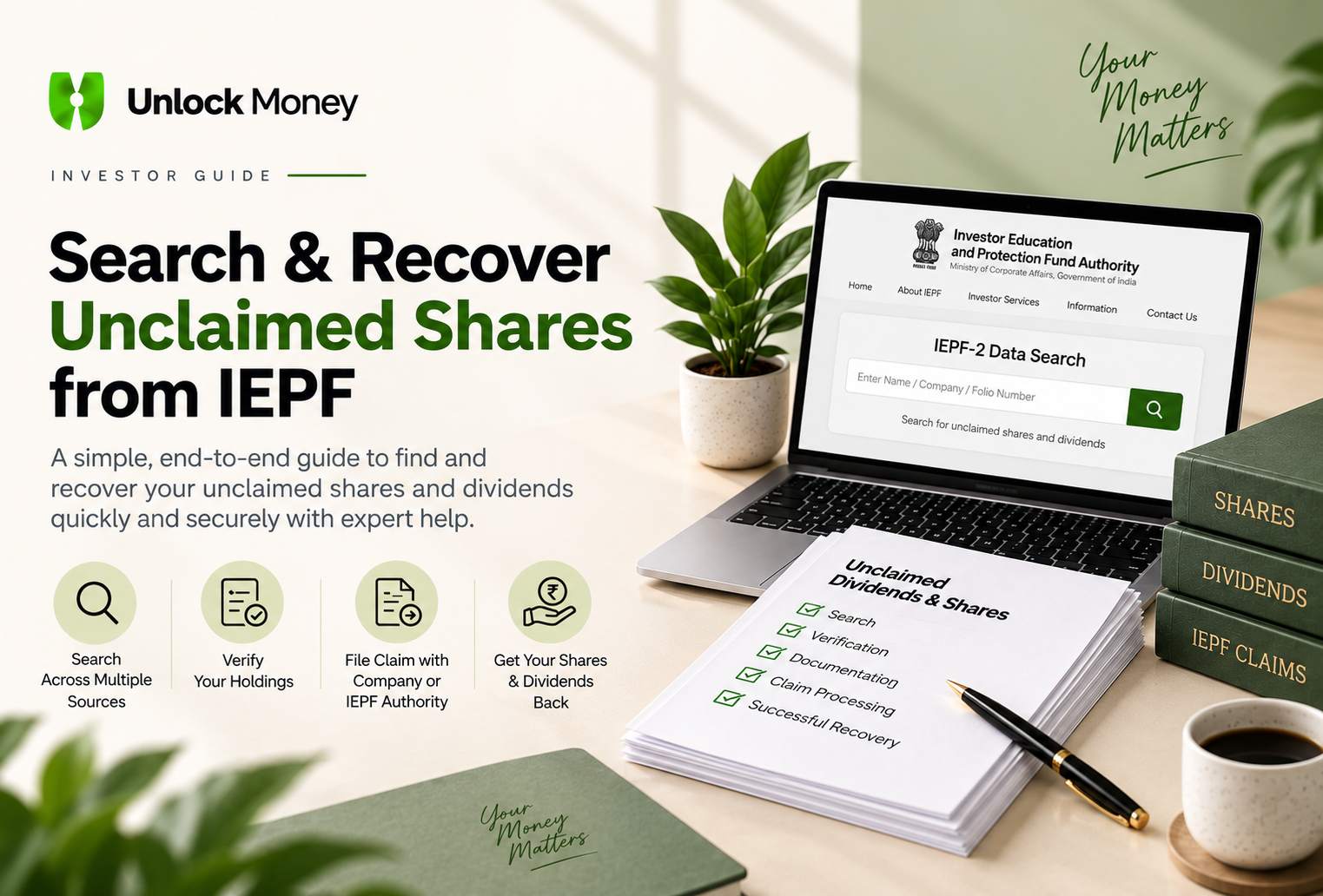
The IEPF-2 Data Search tool at iepf.gov.in allows investors to search by name, company, or folio number to confirm that their shares appear in the IEPF database. This search confirms what is recoverable and provides the details needed for the Form IEPF 5 filing.
Confirm Demat Account Readiness
IEPF releases shares only in electronic form. The claimant’s demat account must be active, KYC-compliant, linked to an operational bank account, and have completed nomination registration. Any issue with the demat account discovered after the claim is approved adds weeks to the timeline. Addressing this before filing is the more efficient approach.
File Form IEPF-5 Online
Form IEPF-5 is the official claim form filed through the Ministry of Corporate Affairs portal. It requires the company’s current Corporate Identification Number, the correct International Securities Identification Number for the shares, the folio number, the demat account DP ID and Client ID, and the specific dividend years covered by the claim. Every field must be accurate and consistent with supporting documents.
Prepare and Submit the Physical Document Package
After online filing, a physical document package must be sent to the company’s Nodal Officer. This package includes the Form IEPF-5 acknowledgement, identity and address proof, a Client Master List from the Depository Participant, a cancelled cheque, an indemnity bond executed on appropriate stamp paper, an advance receipt, and original share certificates where applicable. For deceased investor cases, transmission
documents are also required.
Nodal Officer and IEPF Authority Review
The Nodal Officer verifies the physical documents against the company’s shareholder records and forwards the verification report to the IEPF Authority. The IEPF Authority then reviews the claim and, if satisfied, issues a refund sanction order authorising the release of shares and dividends to the claimant.
Demat Credit and Bank Transfer
Once the sanction order is issued, the shares are credited to the claimant’s demat account and the dividend amount is transferred to their bank account. The timeline from sanction order to credit typically takes one to two weeks.
The IEPF share recovery process is defined and accessible. In theory, any investor can
file a claim on their own. In practice, the gap between a correctly filed claim and a
rejected one comes down to details that are difficult to get right without experience.
Form Errors Reset the Timeline by Months
An incorrect CIN or ISIN in Form IEPF-5 causes an immediate system rejection. A wrong dividend year means the IEPF Authority credits only part of what is owed. A demat account ID entered in the wrong format triggers a technical failure. Each of these errors requires correction and resubmission, which resets the review clock by weeks or months. A first-time correct filing avoids all of this.
Indemnity Bond Format Varies by RTA
The indemnity bond in the physical package must be in the specific format required by the company’s Registrar and Transfer Agent, executed on stamp paper of the correct denomination. RTAs do not accept generic templates, and many have unpublished format requirements that are only known through direct working experience with those RTAs. An incorrectly formatted bond causes the physical package to be returned, resetting the Nodal Officer review clock.
Deceased Investor Cases Require Legal Navigation
When the original shareholder has passed away, the documentation requirements depend on whether a nominee was registered, the value of the assets, the state of residence, and whether a will exists. Getting this assessment wrong, such as obtaining a succession certificate when a legal heir certificate was sufficient, wastes months of time and court fees. Getting it right requires knowing the specific rules for each
scenario.
Multiple Companies Require Simultaneous Management
Many investors with unclaimed shares have holdings across several companies. Each company requires a separate Form IEPF-5 filing, a separate physical package to a different Nodal Officer, and independent follow-up with each company’s RTA. Managing five or ten simultaneous claims across different stages of review is genuinely difficult without a dedicated team.
Unlock Money is a dedicated investor claim service that handles the complete share
recovery process for individuals and families across India. Our approach is built around accuracy, thoroughness, and consistent follow-through.
Comprehensive Initial Search
We search the IEPF portal, company RTA records, and BSE or NSE filings to identify every unclaimed share and dividend that may be owed to you. We check both IEPF and company-held amounts and confirm the current status of every holding before any filing is made. We also check for physical certificate situations that may require additional steps.
Honest Pre-Commitment Assessment
After completing the search, we present you with a clear summary of what is recoverable, which recovery pathway applies to each holding, what the process will involve, and what the realistic timeline looks like. This is done before you commit to our service. You make an informed decision based on actual findings, not assumptions.
Document Preparation to RTA-Specific Standards
We prepare every document in the submission package to match the specific requirements of each company’s RTA. The indemnity bond, advance receipt, request letter, and supporting certifications are all verified against RTA requirements before anything is dispatched. The cancelled cheque, Client Master List, and identity documents are cross-checked for consistency with the Form IEPF-5 inputs. Nothing is
submitted until the complete package is ready.
Form IEPF-5 Filing with Verified Inputs
We verify the current CIN, ISIN, complete folio number, full dividend year history, and demat account details before filing. We confirm each input against current MCA portal records and BSE or NSE company information databases. After filing, we begin immediate tracking of the claim and save the Service Request Number for ongoing status monitoring.
Nodal Officer Follow-Up and Query Resolution
We confirm physical package receipt, follow up proactively when Nodal Officer verification is delayed, and respond immediately to any queries raised. No query goes unanswered. Every response is prepared with the same rigour as the original submission. Clients never experience the timeline reset caused by an unaddressed Nodal Officer query.
IEPF Authority Monitoring Through to Credit
We track claim status at every stage of the IEPF Authority’s review. When the sanction order is issued, we confirm the expected credit dates for both demat and bank transfer. We follow up after the expected dates to confirm receipt and close the case formally.
Deceased Investor and Estate Cases
We assess the specific legal documentation required for each deceased investor case based on the actual facts, not a generic checklist. We advise on whether a legal heir certificate or succession certificate is needed, assist with obtaining it where required, and coordinate all transmission documentation consistently with the IEPF filing.
Physical Certificate and Duplicate Certificate Services
For unclaimed shares still tied to physical certificates, we manage the dematerialisation process alongside the IEPF claim. For lost or damaged certificates, we handle the complete duplicate certificate application, including the FIR, indemnity bond, affidavit, newspaper publication, and RTA submission. Both processes are managed together so neither creates a bottleneck for the other.
Multi-Company Portfolio Recovery
We file simultaneously for all companies with unclaimed shares and provide consolidated tracking and updates across every claim. You have one point of contact for the entire portfolio, regardless of how many companies are involved.
Our investor claim services are built for the full range of situations that result in unclaimed shares.
• Investors who received a communication from a company or RTA about pending IEPF transfer and want to act before or after it happens.
• Investors who confirmed through the IEPF portal that their shares are already in
IEPF and want professional help with the recovery.
• Families who discovered physical share certificates or investment records while
settling a deceased family member’s estate.
• Legal heirs who need to establish their right to unclaimed shares as part of estate administration.
• Investors who attempted a self-filed IEPF Form 5 claim and received a rejection
or a Nodal Officer query they could not resolve.
• NRI investors who held Indian shares before moving abroad and whose dividends have been failing to reach them.
• Investors who hold physical share certificates they never dematerialised and want to understand what dividends may be owed and how to access the shares.
• Anyone who simply wants to know whether they have unclaimed shares and what those shares might be worth today.
A retired professional in Bangalore reached out to Unlock Money after finding a bundle of old share certificates while clearing her late husband’s study. She had no idea how many companies he had invested in, what the shares were worth, or whether any of the certificates were still valid.
Our team ran a comprehensive search across the IEPF portal and RTA records. We found shares from seven companies, five of which had already been transferred to IEPF and two of which were still in the companies’ shareholder registers with unclaimed dividends. The total value of the holdings was substantially more than the client had expected.
We filed five simultaneous IEPF Form 5 claims and initiated a dividend revalidation process with the two companies that still held the dividends. We managed the complete transmission process for each company, obtained the required legal documentation, and handled all correspondence with Nodal Officers and the IEPF Authority.
Within nine months, all seven holdings had been fully recovered. The shares were credited to the client’s demat account and the accumulated unclaimed dividends were transferred to her bank. She did not need to visit a single government office or make a single follow-up call herself.
This is what professional investor claim services look like in practice. The result is not guaranteed for every case, but the approach is the same for every client we work with.
How do I know if I have unclaimed shares in India?
The most direct way is to search the IEPF-2 Data Search tool at iepf.gov.in using the investor’s name, company name, or folio number. You can also check the company’s annual report for an unpaid dividend list or contact the company’s RTA directly. Unlock Money can also run this search for you as a free initial assessment.
Is there a time limit for recovering unclaimed shares from IEPF?
No. There is no deadline for filing an IEPF claim. The government holds unclaimed shares indefinitely, and you can file at any time, whether the shares were transferred to IEPF three years ago or twenty years ago.
Can legal heirs recover unclaimed shares belonging to a deceased investor?
Yes. Legal heirs are fully entitled to recover unclaimed shares on behalf of a deceased investor. The documentation depends on whether a nominee was registered, the value of the shares, and the applicable jurisdiction. Unlock Money provides specific guidance on the correct legal documents for each deceased investor case.
What is the difference between unclaimed shares still with the company and shares already in IEPF?
Shares still within the company’s Unpaid Dividend Account have not yet crossed the seven-year threshold. Recovery in this case involves updating KYC and bank details with the RTA and requesting a fresh dividend payment, which is faster and less document-intensive. Shares already transferred to IEPF require a formal Form IEPF-5 claim through the MCA portal. Unlock Money checks both sources and manages both
recovery pathways.
What if my physical share certificates are lost or damaged?
A duplicate share certificate must be obtained from the company’s RTA before the standard dematerialisation or IEPF claim process can proceed. Unlock Money manages the complete duplicate certificate application alongside the main recovery process.
How long does the full share recovery process take?
For shares still with the company, updating KYC and receiving a revalidated dividend payment typically takes three to six weeks. For IEPF claims, standard cases take three to six months. Cases involving deceased investors, physical certificates, or multiple companies take six to twelve months. Unlock Money provides a case-specific timeline estimate during the initial assessment.
What does Unlock Money charge for share recovery services?
Professional fees depend on the complexity of the case, the number of companies involved, and whether additional processes such as duplicate certificates or succession certificate assistance are required. All fees are disclosed clearly during the initial assessment before you commit. There are no hidden charges.
Unclaimed shares in India represent real wealth that belongs to real people. The law protects your right to recover them. The recovery mechanism exists and is well-defined. What makes the difference between a successful claim and a frustrating cycle of rejections is the accuracy of the process and the quality of the support behind it. Unlock Money provides investor claim services that cover the full range of unclaimed share recovery situations in India, from simple single-company IEPF claims to complex multi-company estate cases involving physical certificates, deceased investors, and years of accumulated dividends. Our team manages every step, from the initial search to the final demat credit, with accuracy, transparency, and consistent follow-through.
If you have unclaimed shares, or if you simply want to know whether you do, the next step is straightforward. Contact Unlock Money at unlockmoney.in for a free initial search. No commitment required. Just a clear picture of what is out there and what it would take to bring it back.
हमसे संपर्क करने में संकोच न करें। हम विशेषज्ञों की एक टीम हैं जो आपसे बात करने के लिए तैयार हैं।